
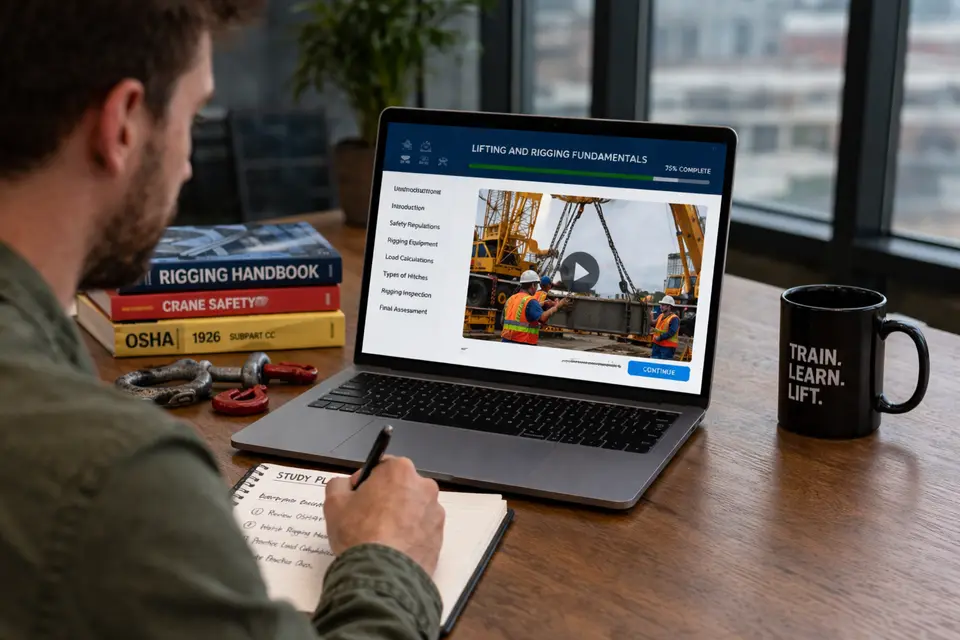
Rigging is where most crane lifts succeed or fail. A perfectly operated crane cannot save a load that is slung with the wrong hitch, a damaged sling or an unknown center of gravity. That is why OSHA requires qualified riggers for many crane activities, and why so many employers and workers are searching for rigging training they can complete without shutting down a job.
Online courses can cover a lot of that ground, but the label "rigging course" hides several very different products. Here is how to tell them apart.
Start With the Question: Qualified or Certified?
OSHA's crane standard requires a qualified rigger for rigging during assembly and disassembly and whenever workers are within the fall zone while hooking, unhooking or guiding a load (29 CFR 1926.1404 and 1926.1425). A qualified person, under OSHA's definition, has a recognized degree, certificate or professional standing, or extensive knowledge, training and experience, and has shown the ability to solve problems related to the work.
That leaves two common routes:
- Employer qualification. The employer documents that a worker has the training and ability to rig the loads they will handle on that job. Training records support that determination.
- Third-party certification. A worker passes accredited written and practical exams from a body such as NCCCO or NCCER and earns a portable credential that other employers recognize.
Neither route is automatically "better." A company with in-house expertise may qualify its own riggers for routine work, while a contractor working for owners who demand third-party credentials will need certified riggers. Check your contract and site rules before choosing.
The Main Types of Online Rigging Courses
Qualification training courses
These courses teach rigging fundamentals, hitches, slings and hardware, and issue a certificate of completion that an employer can keep in its training files. Our Rigger Level I Qualification course is an example. It is designed for documenting crew training, not for earning a third-party card.
Good fit for: employers building training records; new hands who need a structured introduction before working alongside experienced riggers.
Rigger Level I certification exam prep
Prepares candidates for an accredited Rigger Level I written exam. Content usually covers sling types and capacities, hitch configurations, inspection and removal criteria, basic hardware, and signals. Our Rigger Level 1 training course focuses on this.
Good fit for: workers who rig routine lifts where the load weight and center of gravity are known, and who want a credential that travels with them.
Rigger Level II certification exam prep
Level II goes further: estimating load weight, locating the center of gravity, calculating sling tensions at different angles, selecting rigging for more complex picks, and understanding load-turning and multi-crane considerations. See our Rigger Level 2 training course.
Good fit for: experienced riggers, rigging foremen and anyone planning lifts rather than just attaching them.
Signalperson courses
Signal persons direct the operator using standard hand signals or voice communication. OSHA 1926.1428 requires that they be qualified, either through a third-party evaluator or an employer's qualified evaluator. Our signal person training covers the standard signals and communication rules, and many riggers take it alongside their rigging course.
Comparing Course Types at a Glance
| Course type | Purpose | Typical outcome | Hands-on needed? |
|---|---|---|---|
| Qualification training | Document training for employer records | Certificate of completion | Employer evaluates on the job |
| Rigger Level I exam prep | Prepare for accredited written exam | Ready for written and practical exams | Yes, for the practical exam |
| Rigger Level II exam prep | Prepare for advanced written exam | Ready for written and practical exams | Yes, for the practical exam |
| Signalperson prep | Prepare for signal evaluation | Ready for written and practical evaluation | Yes |
Online vs. Hands-On Rigging Training
Online study handles theory well. You can learn sling angle factors, read capacity tags, memorize removal criteria and practice calculations at your own pace. Diagrams and practice quizzes make abstract topics such as center of gravity much easier to grasp.
What a screen cannot do is teach your hands. Tying off a tagline correctly, inspecting a real wire rope for broken wires, or feeling a load start to shift is learned on the ground. For certification, accredited bodies require a practical exam for that reason.
The strongest approach for most crews is to combine the two: learn the theory online, then practice under an experienced rigger on real equipment. NCCCO's Rigger Level I overview and the NCCER Rigger Level 1 overview explain how each body handles the practical side.
What to Look for in Any Online Rigging Course
- Content tied to ASME B30.9 (slings) and B30.26 (rigging hardware), the consensus standards most exam questions reference
- Clear explanation of sling angle and tension calculations with worked examples
- Inspection and removal criteria for wire rope, chain, synthetic web and round slings
- Practice questions with explanations if the course is exam prep
- An honest statement of whether the course leads to a certificate of completion or prepares you for an accredited exam
Practical Questions to Ask a Provider
- Is this course for employer qualification records or for certification exam prep?
- Which certifying body's outline does the exam prep follow?
- How long do I have access, and are practice tests included?
- Is the exam fee included or separate?
- Can a company enroll several workers and track their progress?
Choosing Your Path
If your goal is a portable credential, start with Rigger Level I exam prep and plan for a practical exam. If you already rig daily and plan lifts, Rigger Level II is the better target. If you are an employer documenting crew training, a qualification course may be all you need, backed by your own evaluation of each worker on the job.
For a broader look at providers and formats, see our post on top rigger certification online courses.