
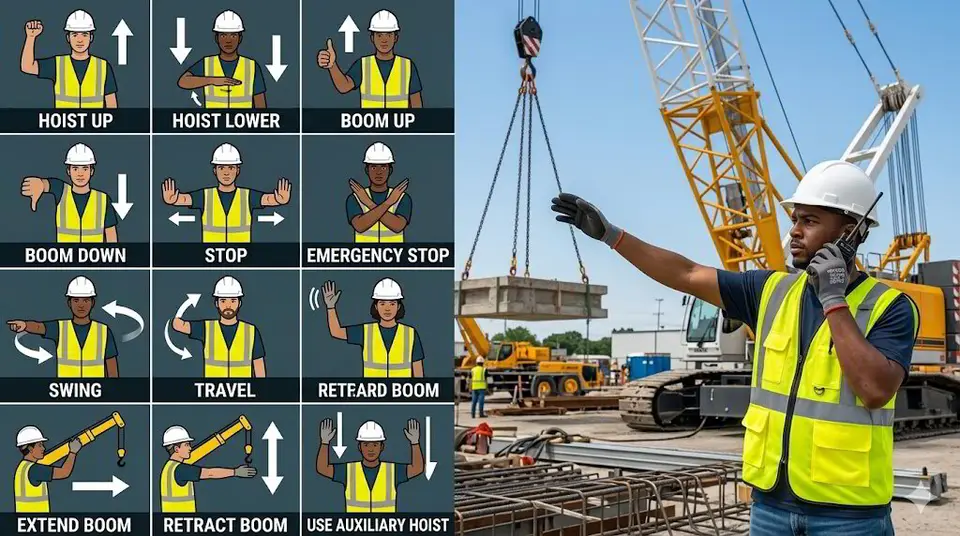
Why the signal person matters
On many lifts the operator cannot see the load, the landing zone or the people near them. The signal person becomes the operator's eyes. A wrong signal, a late stop or an ambiguous gesture can put a load into a worker, a structure or a power line. That is why OSHA treats signaling as a qualified role rather than something any available hand can do.
When OSHA requires a signal person
Under 29 CFR 1926.1419, a signal person must be provided when:
- The point of operation — the load travel or the area near or at load placement — is not in full view of the operator.
- The operator's view is obstructed in the direction the equipment is traveling.
- Either the operator or the person handling the load decides a signal person is needed because of site-specific safety concerns.
In practice, that covers a large share of construction lifts: blind picks over buildings, placements inside structures and tight urban sites.
The OSHA qualification requirements (1926.1428)
OSHA does not mandate a particular certificate. It requires the signal person to be qualified through one of two routes:
- Third-party qualified evaluator — an entity that, because of its independence and expertise, is recognized as able to assess whether someone meets the requirements. Accredited certification programs fill this role. The documentation is portable.
- Employer's qualified evaluator — a person employed by the company who meets the qualified-evaluator definition. This qualification is not portable to other employers.
Either way, the signal person must:
- Know and understand the type of signals used (hand, voice, audible or new signals). If hand signals are used, the Standard Method in Appendix A to Subpart CC applies.
- Be competent in applying those signals.
- Have a basic understanding of equipment operation and limitations, including the crane dynamics involved in swinging, raising, lowering and stopping loads, and boom deflection from hoisting loads.
- Know and understand the relevant requirements of 1926.1419 through 1926.1422 and 1926.1428.
- Demonstrate that they meet these requirements through an oral or written test and a practical test.
If a qualified signal person later shows they no longer meet the requirements, the employer must stop them signaling until they are re-qualified.
Qualification versus certification
| Employer qualification | Third-party certification | |
|---|---|---|
| Who evaluates | Employer's qualified evaluator | Accredited certifying body |
| Testing | Oral or written plus practical | Written plus practical exam |
| Portable to new employers | No | Yes |
| Expiry | Set by employer program | Fixed term (five years for NCCCO) |
Many workers choose certification because it removes the need to be re-qualified each time they change companies, and many contractors prefer it because it simplifies documentation.
What the certification exams cover
NCCCO Signalperson
NCCCO's program has a written exam and a practical exam. The written exam tests knowledge of signals, basic crane operation and limitations, and the relevant OSHA requirements. The practical asks candidates to demonstrate standard hand signals and voice signaling in realistic scenarios. The NCCCO Signalperson overview has more detail.
NCCER Signal Person
NCCER also offers an accredited signal person credential with knowledge and performance components, common among industrial and plant construction employers. See the NCCER signal person page.
Eligibility basics
Certifying bodies set their own eligibility conditions, typically a minimum age and agreement to ethics and substance abuse policies. Check the current candidate handbook before registering.
Knowledge areas to master
- Standard hand signals — hoist, lower, use main hoist, use whipline, raise boom, lower boom, swing, stop, emergency stop, dog everything, travel and the telescoping signals. Practice until each is crisp and unambiguous.
- Voice signal rules — before beginning, the operator, signal person and lift supervisor must agree on the voice signals; each voice signal must include the function, direction, distance and/or speed, and stop. Communication must be through a dedicated channel where required.
- Crane basics — why a load swings when a slew stops abruptly, how boom deflection lowers the load, why radius increases as the boom lowers.
- Power line awareness — the encroachment prevention measures that may require a dedicated spotter.
- Stopping authority — anyone can give the emergency stop signal, and the operator must obey it.
Common signaling mistakes
Examiners and experienced operators see the same errors again and again:
- Sloppy or partial signals. A half-raised arm or a signal given while holding a radio leaves the operator guessing.
- Standing in the wrong place. The signal person must be clearly visible to the operator and positioned to see the load and its path, never under it.
- Multiple people signaling. Only one designated person should give signals at a time, except for the emergency stop.
- Losing sight of the load. If you cannot see the load or the hazard, stop the lift and reposition or hand off to another signal person.
- Assuming the operator knows the plan. Brief the operator before the lift on landing area, obstructions and any special signals.
Avoiding these habits is a large part of what the practical exam evaluates. To compare ways of preparing, see our guide to signal person certification online courses.
How to prepare
- Read 1926.1419–1422 and 1926.1428 on osha.gov; they are short.
- Work through a structured course such as our signal person training, which explains the regulations and crane dynamics in plain terms.
- Practice hand signals in front of a mirror or a colleague until they are automatic.
- Run radio drills with an operator if you can.
- Use practice questions to confirm you are ready for the written exam, then book the practical.
Related credentials
Signal persons often add Rigger Level I because the two roles work side by side on the ground. Together they make you the person a crew relies on to control the hook from below.