
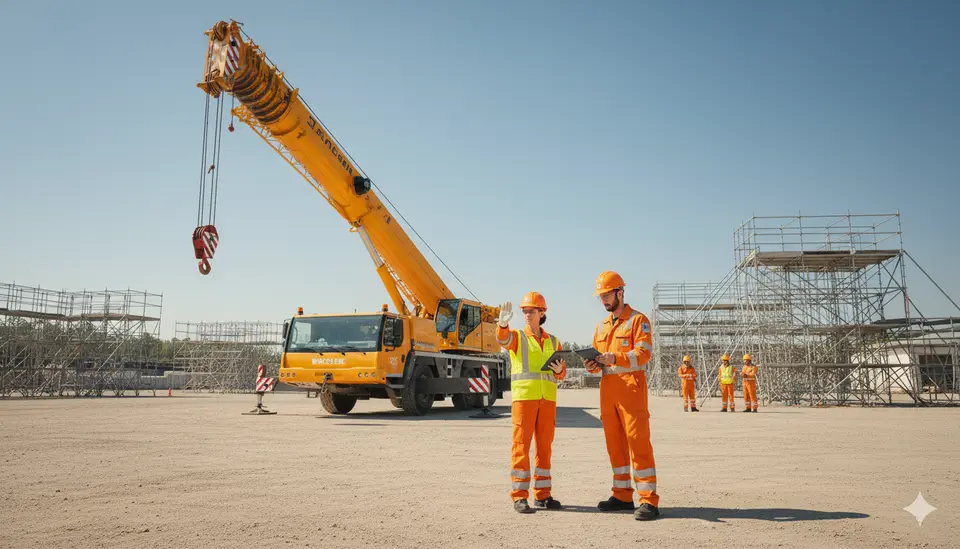
On most crane jobs there comes a moment when the operator cannot see the load: it drops behind a wall, into an excavation or over the roofline. From then on, the lift is only as safe as the person giving signals. OSHA recognizes that, which is why its crane standard spells out when a signal person is needed and what that person must know.
Before comparing courses, it helps to know exactly what you are training for.
Qualification versus certification
Under 29 CFR 1926.1428, a signal person on a construction crane must be qualified. There are two routes:
- Third-party qualified evaluator. An outside organization, such as an accredited certifier, tests and documents the signal person. NCCCO and NCCER signalperson certifications fall into this category.
- Employer's qualified evaluator. The company's own evaluator assesses the person. That qualification is not portable; it applies only while working for that employer.
Either way, the signal person must know and understand the signals in use, be competent applying them, have a basic understanding of crane operation and limitations (including crane dynamics when swinging, raising, lowering and stopping loads, and boom deflection), know the relevant OSHA requirements, and demonstrate all of this through an oral or written test and a practical test.
So the first question is simple: do you need a portable credential you can carry from job to job, or an employer qualification for one company's sites? Many workers choose third-party certification because it travels with them.
The three main course formats
| Format | How it works | Suits | Watch for |
|---|---|---|---|
| Self-paced online | Video, reading and quizzes on your own schedule | Shift workers, people who like to repeat material | Requires self-discipline; practical skills still need in-person practice |
| Live virtual class | Instructor-led sessions over video at set times | Learners who want to ask questions in real time | Fixed times can clash with work |
| Blended or in-person | Classroom theory plus hands-on signal practice, sometimes with an exam on site | Crews training together; people who learn by doing | Travel and scheduling; usually more time away from work |
None of these formats is automatically better. The right one depends on your schedule, how you learn and whether your employer is arranging the practical exam.
What a good course should cover
Whatever the format, check that the curriculum includes:
- The standard hand signals in OSHA's Appendix A to Subpart CC, including the emergency stop.
- Voice signal protocol: identifying the crane, giving direction, distance and speed, and what to do if radio contact is lost.
- Crane dynamics: why loads swing, how booms deflect and why stops must be smooth.
- Operator blind spots and positioning, so you stay visible and out of the fall zone.
- Power line awareness, since signal persons often act as the dedicated spotter.
- Practice questions in the style of the written exam.
Our online signal person training course is built around those topics, and the Signalperson Certification prep and Signalperson Qualification options in our store match the two routes above.
Questions to ask any provider
Instead of chasing the lowest price, ask:
- Which credential does this prepare me for? NCCCO, NCCER or an employer qualification?
- What is included? Practice tests, signal videos, a printable signal chart, instructor contact?
- How long is access? Can you return to the material after the exam?
- How is the practical handled? Does the provider arrange it, or do you book it yourself with a test site?
- What do exam fees cost, and who charges them? Training fees and certifier exam fees are usually separate.
Any provider claiming its course is the certification, or that you can skip the practical, deserves caution. Third-party certification always involves an official written and practical exam.
Understanding the exams
For NCCCO, the signalperson program has a written exam and a practical exam. The practical tests your hand and voice signals in realistic scenarios. NCCER's program also combines knowledge and performance assessment. Details change from time to time, so read the current handbook from the certifying body before you register. The NCCCO signalperson overview and the NCCER signalperson overview summarize each program.
Common mistakes new signal persons make
Exam candidates and new signal persons tend to stumble on the same handful of issues:
- Giving signals from a spot the operator cannot see. Position comes first; a perfect signal is useless if it is hidden behind a column.
- Mixing hand and voice signals mid-lift without agreeing on it beforehand.
- Signalling too fast. Abrupt starts and stops make loads swing, which is exactly the crane dynamics OSHA expects you to understand.
- Forgetting that anyone may give the emergency stop, and that the operator must obey it.
- Directing more than one crane without a clear plan for who is talking to which operator.
Good training addresses each of these directly, usually with short scenario questions.
Getting the most from online study
- Practice signals physically. Stand up and run through every signal in front of a mirror or a colleague, not just on screen.
- Say voice commands out loud. The order of information matters and becomes automatic with repetition.
- Learn the why. Exam questions often test whether you understand dynamics, not just memorized gestures.
- Shadow an experienced signal person on site if your employer allows it.
After you are certified
NCCCO signalperson certification is valid for five years. Many signal persons go on to earn rigger credentials, since the two roles overlap so often; our lifting and rigging certification guide explains that next step.