
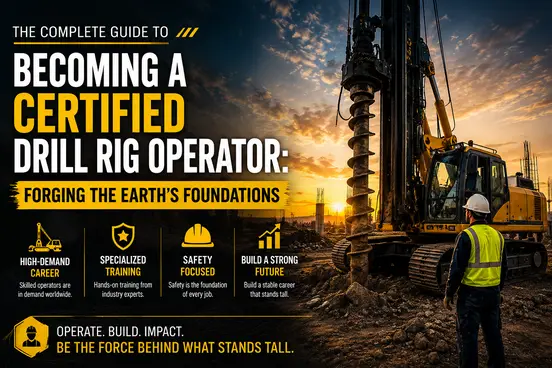
Most of a large structure's foundation is never seen. Under a bridge pier or a tall building, concrete shafts may run far below the surface, transferring load past weak upper soils into material strong enough to carry it. The machine that bores those holes is the foundation drill rig, and the person at its controls is part equipment operator, part geologist and part rigger.
What a Foundation Drill Rig Does
A foundation drill rig, sometimes called a caisson rig or bored-pile rig, excavates cylindrical holes that are later filled with reinforcing steel and concrete. The main components include:
- The mast, a tall vertical structure that guides the drilling tools
- The rotary drive, which turns the drill string and supplies torque
- The kelly bar, a set of nested, telescoping steel bars that extends deep into the ground while keeping the mast at a workable height
- The crowd system, which pushes the tool downward to increase cutting force
- Drilling tools, such as augers for soil, core barrels and rock augers for harder material, and cleanout buckets
- Winches, including an auxiliary line used to lift casing, tools and rebar cages
Some rigs are crawler-mounted for heavy work; smaller units may be truck- or excavator-mounted.
Reading the Ground
Experienced drill operators pay close attention to what comes out of the hole. Ground conditions change with depth, and each layer behaves differently:
- Cohesive soils such as clay can stand open but may stick to tools.
- Loose sands and gravels can cave in, especially below the water table.
- Groundwater can flood a hole and destabilize the sides.
- Rock requires different tooling and a slower, more controlled approach.
To keep holes open, crews use temporary or permanent steel casing, or fill the hole with drilling slurry (bentonite or polymer) that supports the walls with hydrostatic pressure. Knowing when and how each method applies, and recognizing the signs of a cave-in or loss of slurry, is a core operator skill. The geotechnical report and the engineer's specifications govern these decisions, and the operator works within them.
Where Drilling Meets Hoisting
A drill rig does more than drill. Its auxiliary winch is used to lift and set casing, swap tools and lower heavy rebar cages into the finished hole. When a rig hoists and moves suspended loads like these, OSHA's crane and derrick standard (29 CFR 1926 Subpart CC) can apply to that activity, including operator qualification, rigging and signaling requirements. How the rule applies depends on the equipment and the task, so ask your employer's safety team and review the OSHA standard for specifics.
That hoisting work is why riggers on drilling crews matter. A rebar cage is long, flexible and awkward, and picking it from horizontal to vertical without permanent deformation takes planning. Many drilling crews have members with formal rigging training; our Rigger Level 1 course covers the fundamentals.
Major Hazards on a Drilling Site
Overhead power lines
A tall mast moving across a site, or being raised, can contact overhead lines. The same planning used for cranes applies: identify lines before work begins, keep the required clearances, and use spotters when working near the limits. OSHA's power line provisions for cranes are found in 1926.1407 through 1926.1411.
Underground utilities
Drilling into a gas line, water main or buried electrical cable is a serious hazard. Utility locates are essential, but they are not perfect, so operators watch for unexpected changes in resistance or material.
Open holes
An uncovered shaft is a fall hazard for people and equipment. Holes are covered, barricaded or guarded whenever they are not being worked.
Rig stability
Drill rigs carry a lot of weight high on the mast. Soft ground, slopes, and the forces of drilling and extraction can all threaten stability. Working platforms and ground preparation must match the manufacturer's requirements.
Rotating equipment
Kelly bars, augers and rotary drives can entangle clothing and limbs. Exclusion zones around rotating parts are basic site discipline.
The NCCCO Drill Rig Operator Certification
NCCCO offers a Drill Rig Operator certification for foundation drill rigs. As with its other programs, candidates pass a written exam and a practical exam and must meet NCCCO's eligibility and policy requirements. The written exam draws on site preparation, rig setup, ground conditions, operational practices, hoisting and safety rules. Our NCCCO drill rig certification overview explains the structure; always confirm details in NCCCO's current Candidate Handbook.
Certification is increasingly expected by general contractors and project owners on bridge, transportation and industrial work, and it gives operators a portable credential that travels between employers.
Preparing for the Written Exam
Drill rig operators often work long days on remote jobs, which makes classroom schedules hard to keep. Online study lets you prepare between shifts. Useful preparation includes:
- Reviewing rig components, controls and inspection points
- Studying soil types, groundwater behavior, casing and slurry methods
- Learning the hoisting, rigging and signaling rules that apply to the auxiliary line
- Reviewing power line and utility hazard procedures
- Taking practice questions until your scores are consistently strong
Our drill rig training course organizes these topics into an exam-focused curriculum, and you can enroll through the Drill Rig Operator Certification Prep listing. Online prep covers the written side only; the practical exam requires hands-on time on a rig.
Building a Career in Deep Foundations
Many drill operators start as laborers or oilers on foundation crews, learn the tools and soil conditions, then move onto the controls under an experienced operator. Related paths include pile driving, which shares many sites and contractors with drilled shaft work. If that interests you, read our guide to becoming a dedicated pile driver operator.
Experienced operators may move into superintendent, estimating or equipment management roles. NCCCO certifications are valid for five years, so keeping yours current is part of the long-term plan.