
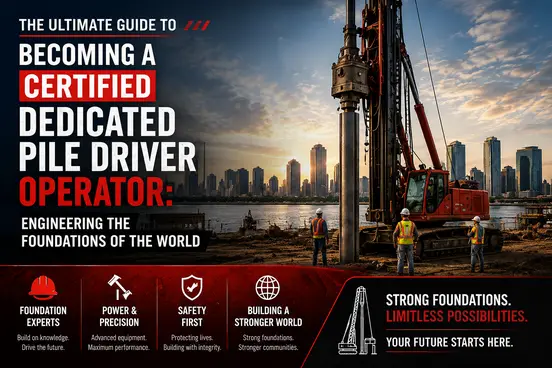
Bridges over soft river silt, port wharves and tall buildings on poor soil all share one thing: they sit on piles driven down to material strong enough to carry them. The person who places those piles is the dedicated pile driver operator, and the job looks very little like ordinary crane work. A crane operator tries to set a load down gently. A pile driver operator stands a long, heavy pile upright, holds it plumb, then hammers it into the ground over and over.
That difference shapes everything about the trade, from the machine's anatomy to the knowledge NCCCO tests before it will issue a Dedicated Pile Driver (DPD) certification.
How a dedicated pile driver is put together
Most dedicated rigs ride on a crawler base. Tracks spread the machine's weight over a wide area and keep it steady on the soft, wet ground typical of foundation jobs.
Leads
Instead of a hook hanging free from the boom tip, the boom supports a tall steel guide called the leads (said "leeds"). Leads do two jobs: they keep the pile straight while it is driven, and they act as rails for the hammer as it rides up and down. On a dedicated machine the leads are attached at the top of the boom and connected near the base of the carrier.
The spotter
That lower connection is a hydraulic arm known as the spotter. Extending or retracting it pushes the foot of the leads out or pulls it in, which lets the operator tilt the whole assembly. Tilting is how crews drive batter piles, which go in at an angle to resist sideways forces. The spotter is one of the clearest features separating a dedicated pile driver from a crane simply holding swinging leads.
Hammers
Operators are expected to understand the main hammer families:
- Drop hammers – a weight is winched up the leads and released.
- Diesel impact hammers – a falling ram compresses and ignites fuel, which drives the pile and throws the ram back up for the next blow.
- Hydraulic impact hammers – hydraulic pressure lifts (and on some models accelerates) the ram, giving fine control over stroke.
- Vibratory hammers – rotating eccentric weights shake the pile so it slips into the soil rather than being struck.
Each type loads the machine differently, which is why hammer knowledge shows up on the exam.
Pitching the pile: where stability is won or lost
Before anything is driven, the pile must be lifted from horizontal and stood up inside the leads. Crews call this pitching. It is one of the most hazardous phases of the work because the load geometry changes continuously: the top rises while the bottom drags or swings, and the machine's center of gravity moves with it.
Pulling at an angle can put side load on the boom, sheaves and leads, which they are not built to carry. Good operators keep the machine level, keep the hoist line as close to plumb as conditions allow and stop if the pile starts to swing. Wind matters too. Tall leads with a hammer at the top present a large surface to gusts, and manufacturers publish wind limits that the operator must respect.
Reading a DPD load chart
Pile driver charts have to account for the driving equipment hanging off the machine. When working out what the rig can safely handle, the operator considers the leads, the spotter, the hammer, the helmet (the cap that sits on the pile head), and any cushion or striker components, not just a hook block and slings.
Geometry changes the answer. A plumb pile is the simplest case. Driving at a batter moves weight outward, and the manufacturer's charts limit how far the leads can be tilted for a given combination of boom, leads, hammer and pile. Repeated impact also sends shock back through the structure, so staying inside the chart while driving is not optional. If you want structured practice with chart questions, the crane practice test bank is a useful complement to manufacturer manuals.
Hazards around the rig
The ground crew, often called pile bucks, works close to suspended piles and heavy hardware. They attach slings, guide the pile toe into the leads and seat the helmet. Several risks deserve constant attention:
- Noise. Impact hammers make voice communication unreliable. Crews rely on standard hand signals or radios, and if the operator loses sight of the signal person, movement stops.
- Crushing and struck-by. A dropped pile or failed sling can trap anyone guiding the toe. Ground crews with formal rigging training, such as Rigger Level I preparation, are better equipped to judge sling angles and reject damaged gear.
- Power lines. Tall leads reach into the zone around overhead conductors. OSHA's power line provisions in 29 CFR 1926.1407–1411 set out clearance and planning requirements that apply to this equipment.
- Fatigue damage. Constant vibration loosens fasteners and opens cracks in welds.
Daily inspection in a vibrating world
Because the machine spends its working life shaking, the walkaround is more demanding than on many cranes. Operators look for cracked welds on the boom, leads and spotter, check that pins and bolts have not backed out, and pay close attention to the hammer hoist line. Wire rope on a pile rig sees repeated jerking loads, so broken wires, distortion and diameter loss need to be caught early and the rope removed from service according to the manufacturer's and applicable ASME criteria.
The NCCCO Dedicated Pile Driver credential
Dedicated pile drivers are addressed within OSHA's cranes and derricks standard (29 CFR 1926 Subpart CC), which includes a section specific to these machines that modifies how some general requirements apply. Requirements can depend on the machine and the work, so confirm with your employer or OSHA which provisions cover your equipment. Separately, many contractors and project owners simply require a recognized credential.
NCCCO's DPD program is built around two parts:
- A written exam on pile driver operations, including hammer types, leads and spotter use, chart interpretation and site hazards.
- A practical exam in a dedicated pile driver, where an examiner scores control, smoothness and response to signals.
Exam structure and eligibility details can change, so read the current NCCCO candidate handbook at nccco.org before you register. Our NCCCO dedicated pile driver overview summarizes what the credential involves, and the online pile driver training course covers the written material.
Fitting study around foundation work
Pile crews travel, start early and often finish late. Self-paced online study suits that rhythm: a module on batter geometry one evening, a set of practice questions during a weather delay the next. What online prep does not do is replace seat time or the practical exam, which must be taken in person on a real machine. Use the course to master the theory, then work with your employer or a test site to get hands-on practice. Our practical training and seat time guide explains how those two halves fit together.
If you are weighing several foundation-equipment credentials, it also helps to read how a related specialty is earned; our guide to becoming a certified drill rig operator covers another machine that often shares a site with pile drivers.
Key takeaways
- A dedicated pile driver combines a crawler base, fixed leads, a spotter and an interchangeable hammer.
- Pitching the pile and driving at a batter are where stability margins shrink fastest.
- DPD charts include the weight of driving attachments, not just rigging.
- NCCCO's DPD credential pairs a written exam with a hands-on practical exam.
- Online prep builds the knowledge; the practical exam and real seat time build the skill.