
A knuckleboom that lifts 8,000 pounds close to the column may be good for less than 2,000 at full reach, and the lever feels the same in both places. No operator can feel an overload coming. You need to know what each safety system does, what OSHA requires when one fails, and what none of them can do.
Why a knuckleboom needs overload protection
Capacity falls as reach grows, because the same load at a longer reach makes a bigger load moment. Without a limit, the cylinders may be strong enough to push the crane past what its structure or its stability can take. An overload protection system steps in before that happens.
How overload protection works
There are two common designs.
Pressure-based systems. A sensor reads the oil pressure in the inner boom (lift) cylinder. That pressure rises with load moment. When it reaches the set limit, the system blocks the functions that would raise it further.
Electronic rated capacity limiters. Pressure sensors, and on some cranes angle, extension and stabilizer sensors, feed a computer. A display shows the percentage of capacity in use, warns as the crane nears the limit, and blocks functions at the limit.
OSHA 1926.1401 describes what a load moment (rated capacity) limiter does: when rated capacity is reached, it shuts off power to the functions that can increase the severity of loading, such as hoisting, telescoping out or luffing out. Functions that decrease the severity of loading, such as lowering, telescoping in or luffing in, typically stay available.
What to do when it stops you. Use a motion that reduces load moment. Retract the extensions to bring the load closer, then set it down. Do not reach for an override. Where one is fitted, it is for the emergency use the manufacturer describes and nothing else.
What OSHA requires on an articulating crane
Subpart CC sorts devices into two groups, with a different rule for each when one fails.
| Group | Devices that apply to articulating cranes | If it is not working |
|---|---|---|
| Safety devices (1926.1415) | Crane level indicator; horn; integral holding device or check valve on hydraulic stabilizer jacks; locks on foot-pedal brakes if fitted | Operations must not begin. If it fails during work, stop safely. The crane stays out of service until the device works. Alternative measures are not permitted |
| Operational aids, Category I (1926.1416(d)) | Anti-two-block device on articulating cranes built after December 31, 1999 that have a load hoist | Stop safely until the temporary alternative measure is in place. Repair within 7 calendar days |
| Operational aids, Category II (1926.1416(e)) | On articulating cranes built after November 8, 2011, at least one of: automatic overload prevention device, load weighing device, load moment (rated capacity) indicator, load moment (rated capacity) limiter. On equipment built after that date with stabilizers: a stabilizer position sensor or monitor | Stop safely until the temporary alternative measure is in place. Repair within 30 calendar days |
Details worth knowing:
- The parts exception. If the employer documents that the parts were ordered within 7 calendar days of the failure, and for Category II they do not arrive in time to finish within 30 days, the repair must be finished within 7 calendar days after the parts arrive.
- Temporary alternative measure for the overload device: the load's weight must be determined from a source the industry recognizes, such as the load's manufacturer, or by a recognized calculation method, and given to the operator before the lift.
- Temporary alternative measure for the anti-two-block device: mark the cable so the operator can see it in time to stop, or use a spotter. If two-blocking could happen without the hoist moving, mark the cable and also use a spotter when extending the boom.
- Temporary alternative measure for the stabilizer position sensor: the operator verifies that the stabilizers are positioned as the manufacturer requires.
- Not required on articulating cranes. Under 1926.1416(a)(1), the boom angle or radius indicator, jib angle indicator and boom length indicator requirements do not apply to articulating cranes.
One more rule depends on this device. Under the material-delivery exclusion in 1926.1400(c)(17), a delivery onto a structure stays outside Subpart CC only when the truck crane has a properly functioning automatic overload prevention device. Module 3 explains.
Other protective systems
Earlier lessons covered load-holding valves, relief valves and emergency stops. Depending on its age and model, your crane may also have stabilizer monitoring, which on some cranes reduces capacity or blocks slewing toward a side that is not fully set, and a stowed-position warning, a cab light or buzzer that tells the driver the boom or a stabilizer is not stowed. Check your manual.
What the systems cannot do
OSHA 1926.1417(k) says safety devices and operational aids must not be used as a substitute for the operator's professional judgment. Here is why.
- They cannot see the ground. A stabilizer can punch through soft soil while the crane is well inside its rated capacity.
- They may not cover everything on the boom. A system that reads lift cylinder pressure may not protect a manual extension, a winch or an attachment, each of which has its own lower rating.
- They react slowly to shock. A load that is snatched or swung adds force faster than a system can respond.
- They do not measure side load. Dragging a load or working out of level bends the boom sideways without raising lift cylinder pressure much.
- They do not check the rigging. A sling can be overloaded long before the crane is.
- They can be tampered with. A bypassed system protects nothing.
So 1926.1417(o) still requires the operator to verify that the load is within rated capacity.
Never bypass, wedge or re-adjust a protective device. A crane that will not lift the load is telling you the load is too heavy or too far out.
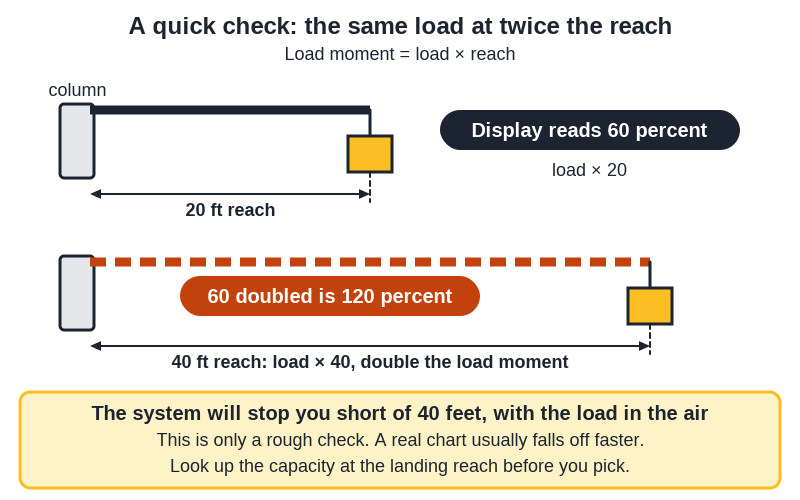
A quick check with numbers
Your display reads 60 percent with the load at a 20 foot reach. You need to place it at 40 feet. Will the crane get there?
- Load moment at 20 feet is the load × 20. At 40 feet it is the load × 40, which is double.
- Sixty percent doubled is 120 percent, before counting the extra boom now extended.
No. The system will stop you short of 40 feet with the load in the air. This is only a rough check. A real chart usually falls off faster than that, so the true figure is worse. Look up the capacity at the landing reach before you pick.
On the exam: Know which group a device is in and what happens when it fails: safety device, out of service with no alternative; operational aid, temporary alternative measure and a repair deadline of 7 or 30 calendar days. Know that an overload system blocks motions that increase load and leaves motions that reduce it. Expect a question whose right answer is that a device does not replace the operator's judgment.
Key points
- Overload protection blocks motions that increase load moment and allows motions that reduce it. When it stops you, bring the load in and set it down.
- Articulating cranes built after November 8, 2011 must have an overload prevention device, a load weighing device, or a load moment indicator or limiter.
- Winch cranes built after December 31, 1999 must have an anti-two-block device.
- A failed safety device (1926.1415) takes the crane out of service. Alternative measures are not permitted.
- A failed operational aid (1926.1416) needs a temporary alternative measure and repair within 7 calendar days (Category I) or 30 calendar days (Category II).
- No device sees the ground, the rigging, side load or shock load. They never replace the operator's judgment (1926.1417(k)).
- Never bypass a protective device.