
Newsletter

Free Printable Crane Hand Signal Chart

Sign up for our email newsletter and open a print-ready copy of OSHA's Standard Hand Signals chart straight away. It is the official chart, unchanged, laid out to print on Letter paper.

  • OSHA's own chart
  • 19 signals
  • Prints on Letter paper
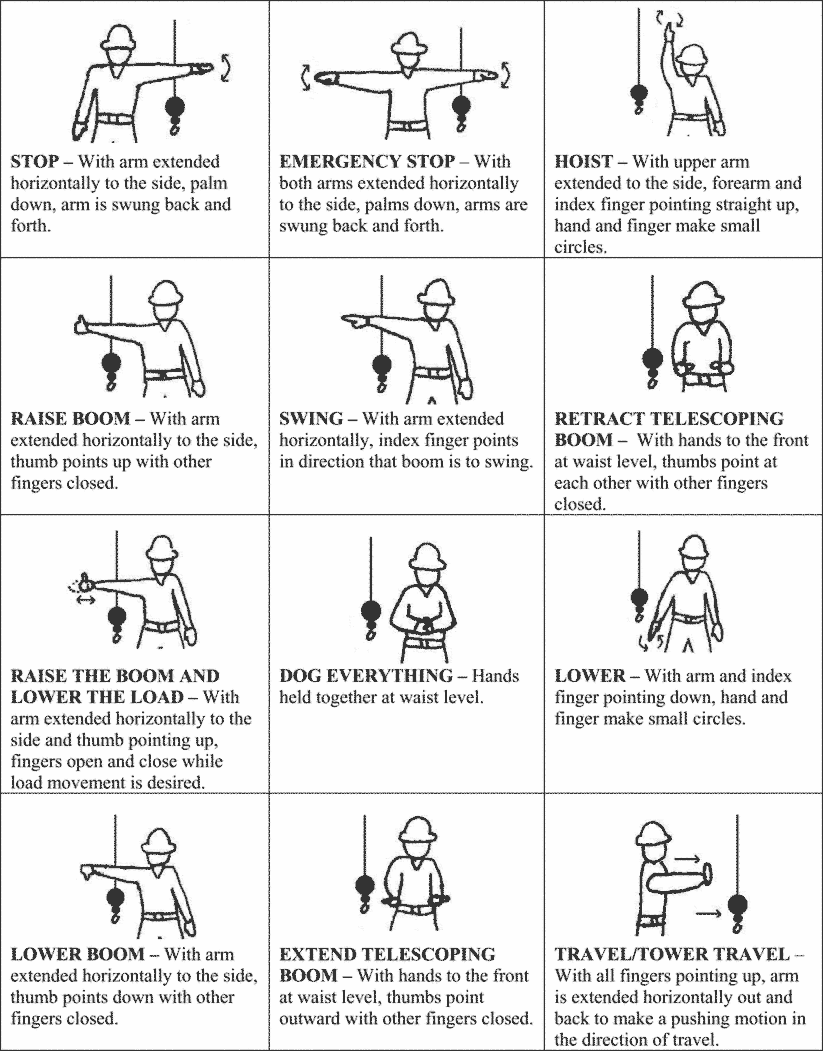
OSHA Standard Hand Signals chart, part 1: Stop, Emergency Stop, Hoist, Raise Boom, Swing, Retract Telescoping Boom, Raise the Boom and Lower the Load, Dog Everything, Lower, Lower Boom, Extend Telescoping Boom, Travel/Tower Travel
A small view of the first sheet. The printable version is full size, on two sheets.

Sign up and open the chart

Enter your email address. The printable chart opens straight away, on this page.

What Is on the Chart

The chart is OSHA's Standard Hand Signals chart: Appendix A to Subpart CC of 29 CFR Part 1926, the federal crane rule for construction. It shows 19 signals, each with a drawing and a one-line description. We reproduce OSHA's chart exactly as published. No signal has been redrawn or changed.

The 19 signals fall into four groups:

  • Basic: Stop, Emergency Stop, Hoist, Lower.
  • Boom: Raise Boom, Lower Boom, Extend Telescoping Boom, Retract Telescoping Boom.
  • Direction and travel: Swing, Travel/Tower Travel, Crawler Crane Travel Both Tracks, Crawler Crane Travel One Track, Trolley Travel.
  • Advanced: Move Slowly, Use Main Hoist, Use Auxiliary Hoist (whipline), Dog Everything, Raise the Boom and Lower the Load, Lower the Boom and Raise the Load.

What OSHA Says About the Chart

Three rules from Subpart CC that every crane crew should know.

Use the Standard Method

"When using hand signals, the Standard Method must be used" (29 CFR 1926.1419(c)(1)). The Standard Method is the chart in Appendix A.

Post the chart

"Hand signal charts must be either posted on the equipment or conspicuously posted in the vicinity of the hoisting operations" (29 CFR 1926.1422).

Agree anything else first

A signal that is not on the chart may be used only where the Standard Method is infeasible or does not cover the operation, and the signal person, the operator and the lift director (where there is one) must agree on it before the operation (29 CFR 1926.1419(c)).

A chart inside a locked gang box does not meet the posting rule. Put it where the crew can see it.

What the Newsletter Is

Short emails for crane operators, riggers, signal people and the people who employ them: study tips, changes to the rules and the exams, new free lessons and practice questions, and news from the school. We send it now and then, not every day.

You can stop any time. Every email has a link that takes you off the list, and you can also write to us and we will remove you by hand. We do not sell your address.

Questions About the Newsletter and the Chart

Is this the official OSHA hand signal chart?

Yes. It is OSHA's Standard Hand Signals chart from Appendix A to Subpart CC of 29 CFR Part 1926, reproduced unchanged. Our sheet adds only a header with the school's name and a line saying where the chart comes from.

Do I have to sign up to get the chart?

The chart is our thank-you for signing up to the newsletter, and it opens as soon as you do. OSHA also publishes the same chart in the regulation itself (Appendix A to Subpart CC of 29 CFR Part 1926), which anyone can read on osha.gov.

How do I stop the newsletter?

Use the link at the bottom of any email from us, or write to info@theonlinecraneschool.com and we will take you off the list.

Does posting the chart make someone a qualified signal person?

No. Under 29 CFR 1926.1428 a signal person must be qualified by a qualified evaluator, which includes a practical test. The chart is a reference. Our Signalperson course teaches every signal on it.

Keep Exploring

Free signal person practice quiz

Ten practice questions with every answer explained.

Free signal person sample lesson

The operator's view and blind spots, in full.

Signal person training online

What the course covers and how certification works.