
OSHA's first reason for using a signal person is simple: the operator cannot see what needs to be seen. To do this job well you have to picture the lift from the operator's seat, know what is hidden from there, and know which way the operator's "left" and "right" point.
What the operator sees from the cab
The cab of a mobile crane sits beside the boom on the upperworks. From the seat the operator can usually see the boom, the load when it is in front and in the open, and the ground nearby. The view is limited in several ways:
- The boom itself blocks part of the view, especially on the side opposite the cab.
- Structures hide the load once it goes over a roof edge, behind a wall, into a building opening, or down into a pit, trench or shaft.
- The counterweight and carrier hide the area behind and below the crane, which is also where the swinging counterweight can crush someone.
- Distance and depth are hard to judge. From the cab, a load 3 feet from a wall and a load 10 feet from it can look the same.
- Height. On a tower crane the operator may be far above the hook and have to look almost straight down, or may lose sight of the load for most of the lift.
- Light and weather. Glare, low sun, rain on the windows, dust and darkness all shrink the view.
The point of operation
OSHA requires a signal person whenever "the point of operation, meaning the load travel or the area near or at load placement, is not in full view of the operator" (1926.1419(a)(1)). Notice how wide that is. It is not only the landing spot. If any part of the load's path is out of full view, a signal person is required for that part of the lift.
Examples of a point of operation not in full view:
- Setting a rooftop unit on the far side of a parapet wall.
- Lowering pipe into a trench where the operator cannot see the bottom.
- Picking a load from behind a building or a stack of material.
- Landing a load inside a structure through an opening.
- Any tower crane lift where the hook goes below the deck edge or behind the building.
Blind lifts
A blind lift (also called a blind pick) is any lift where the operator cannot see the load at some point. On blind lifts:
- You must be able to see the load and the landing area, and you must be in communication with the operator, by sight or by radio, the whole time.
- If you cannot see the operator and the operator cannot see you, hand signals will not work. Use radio, or set up a relay with a second person in view of the operator, as the employer's plan allows. (Only one person may give signals to the crane at a time, so a relay must be planned carefully. Module 6 covers this.)
- Silence must never mean "keep going". On radio, keep talking so the operator knows you are there.
Operator's direction perspective
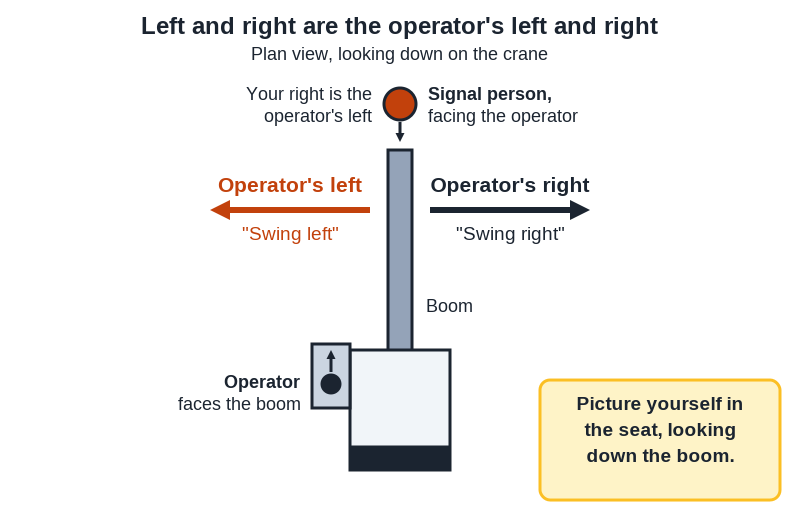
OSHA requires all directions given by the signal person to be given from the operator's direction perspective (1926.1419(k)). "Swing left" means swing to the operator's left, as the operator sits facing the boom. It does not mean your left.
This catches people every day. If you face the operator, the operator's left is on your right. A simple way to stay right:
- Before the lift, picture yourself sitting in the seat looking down the boom.
- Call directions as that person would see them.
- With hand signals, point with the swing signal in the direction the boom is to swing. The OSHA swing signal is "index finger points in direction that boom is to swing", so you point where you want the boom to go, which removes most left and right confusion.
- With voice signals, use "left" and "right" from the operator's view, and if there is any doubt, use landmarks agreed in advance ("swing toward the stair tower").
Watch the narrated video in the course portal.
Where the operator needs you to stand
The operator must be able to see you clearly when you use hand signals, and you must be able to see the load and its path. That usually means standing:
- In the operator's clear line of sight, not behind the boom or in the glare of the sun behind you.
- Where you can see the load, the landing area and the people near it.
- Clear of the load's path, the fall zone and the counterweight's swing.
- Far enough away that the operator can see your whole upper body and arms.
Module 7 covers positioning in detail.
What the operator expects of you
From the seat, the operator is trusting you to:
- Know the plan: what is being lifted, where it goes, the route, and the hazards along it.
- Give one clear signal at a time, and keep giving it as long as the motion should continue.
- Give the stop signal early enough for the load to stop where it should.
- Tell the operator when you are going out of sight, before you do.
- Never signal a motion that will move the load over people.
And OSHA requires the operator to obey a stop or emergency stop signal, no matter who gives it (1926.1417(y)).
On the exam: Expect questions on when a signal person is required because of the operator's view, on what "point of operation" means, and on the operator's direction perspective. If a question says the signal person is facing the crane and wants the boom to swing toward the signal person's right, the operator will be swinging to the operator's left.
Key points
- The boom, structures, distance, height, light and weather all limit the operator's view.
- A signal person is required whenever the load travel or the area near or at load placement is not in full view of the operator (1926.1419(a)(1)).
- On a blind lift you must keep sight of the load and continuous communication with the operator.
- All directions are given from the operator's direction perspective (1926.1419(k)).
- Stand where the operator can see you and you can see the load, clear of the load path and the counterweight.