The type of crane decides what it can do, where it can go, how it is set up and which certification you need to run it. An operator who knows the limits of each type picks the right machine for the job and does not ask a crane to do something it was never built for.
What counts as a mobile crane
OSHA's crane rule defines a mobile crane as a lifting device with a cable suspended lattice boom or a hydraulic telescopic boom, designed to be moved between operating locations by transport over the road (29 CFR 1926.1401). The rule itself reaches much further. Section 1926.1400 lists crawler cranes, wheel-mounted, rough terrain, all terrain, commercial truck-mounted and boom truck cranes, industrial cranes such as carry deck cranes, and many others.
All of them share three motions: they hoist (raise and lower the load), they swing (rotate the boom), and they change radius by raising or lowering the boom or, on a telescopic crane, by extending and retracting it.
Two boom families
| Telescopic boom | Lattice boom | |
|---|---|---|
| How it is built | Steel box sections that slide inside each other | Pinned sections of welded tube (chords and lacings) |
| How it changes length | Hydraulically, in seconds, from the cab | By adding or removing sections on the ground |
| How it is raised | Hydraulic lift cylinder | Wire rope and pendants to a gantry or mast |
| Strong point | Fast setup, compact, flexible | Light for its length, so long reach and heavy capacity |
| Weak point | Heavy boom eats into capacity at long reach | Must be assembled on site, with room to lay the boom out |
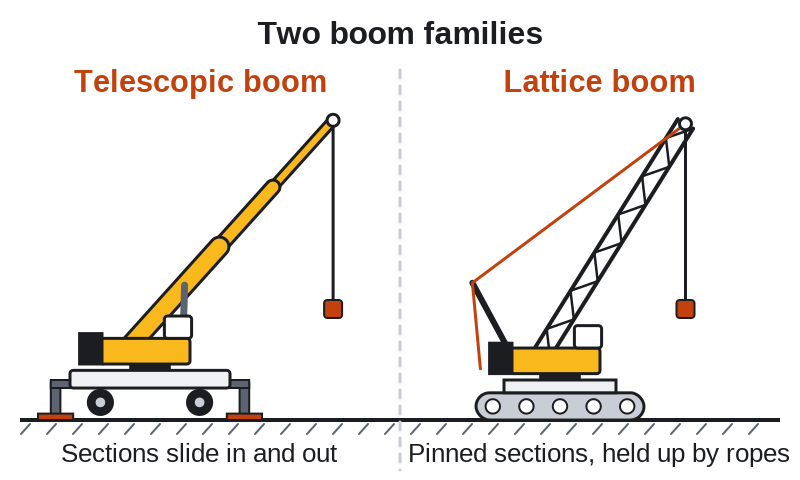
"Hydraulic crane" is the everyday name for a telescopic boom crane.
Telescopic boom cranes
| Type | How to recognize it | Where it shines | Limits to remember |
|---|---|---|---|
| Rough terrain (RT) | Two axles, large tires, four-wheel drive and steer, one cab on the upperworks used for driving and lifting | Unpaved sites; can lift on tires and pick and carry where the chart allows | Usually hauled to the job on a trailer; slow |
| All terrain (AT) | Several axles, all-wheel steering, usually a driving cab below and an operating cab above | Drives on the highway and copes with rough sites; long booms | Heavy and complex; on larger models the counterweight travels on a separate truck |
| Truck crane (telescopic) | Crane upperworks on a carrier built for the highway, with separate driving and operating cabs | Quick moves between paved or firm sites | Less able off-road; lifting over the front is restricted unless the manufacturer permits it |
| Boom truck | Telescopic crane mounted on a commercial truck chassis, often with a flatbed | Delivers and sets material in one trip | Lower capacity; often on stabilizers; chart limits by working area |
| Carry deck (industrial crane) | Small, low crane with a flat deck around a rotating boom | Tight spaces in plants and yards; carries loads on its deck | Small capacity; short reach; needs firm, level floors |
A telescopic boom can also be mounted on crawler tracks. It combines the quick boom of a hydraulic crane with the low ground pressure and travel ability of a crawler.
Swing cab or fixed cab
CCO certifies telescopic boom cranes in two designations, and the difference is the operator's station.
- Swing cab (TLL). The cab is on the rotating upperworks. You turn with the boom, so the boom and the load are always in front of you. Rough terrain cranes, all terrain cranes and telescopic truck cranes are swing cab machines.
- Fixed cab (TSS). The operator's station is fixed to the carrier and does not rotate with the boom. The boom swings around you, and at some positions you look at the load over your shoulder or cannot see it at all. Most boom trucks and carry deck cranes are fixed cab machines.
Decide by looking at the crane, not by its name. A boom truck with a cab that rotates with the boom is a swing cab crane.
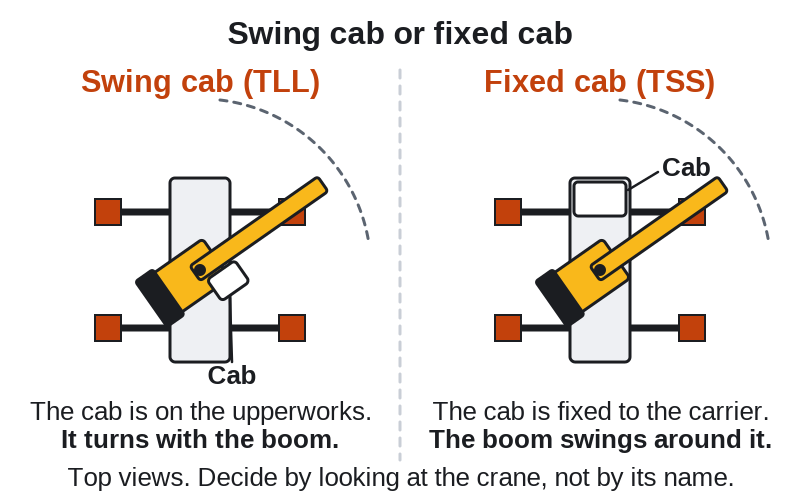
Why does the cab matter enough to split the certification? Your view. In a swing cab the sight line down the boom never changes. In a fixed cab you must keep track of where the boom is in relation to the truck, because capacity often changes between the rear, the sides and the front, and your depth judgment changes with it.
Lattice boom cranes
| Type | How to recognize it | Where it shines | Limits to remember |
|---|---|---|---|
| Lattice boom crawler | Lattice boom, rides on two tracks, no outriggers | Heavy lifts, long booms, soft ground, travelling with a load where the chart allows | Must be trucked in pieces and assembled; needs a firm, level path |
| Lattice boom truck crane | Lattice boom on a highway carrier with outriggers | Long reach with road mobility | Boom must be assembled on site; needs room to lay the boom out |
A crawler spreads its weight over the long track surface, so its ground pressure is lower than an outrigger float carrying the same share of the load. It still needs firm, level ground, and often mats.
Lattice boom cranes have their own Specialty exam and their own specialty course, as the telescopic boom designations do. The Core exam can still ask about them, because Core covers what every mobile crane operator must know.
On outriggers, on tires, on tracks
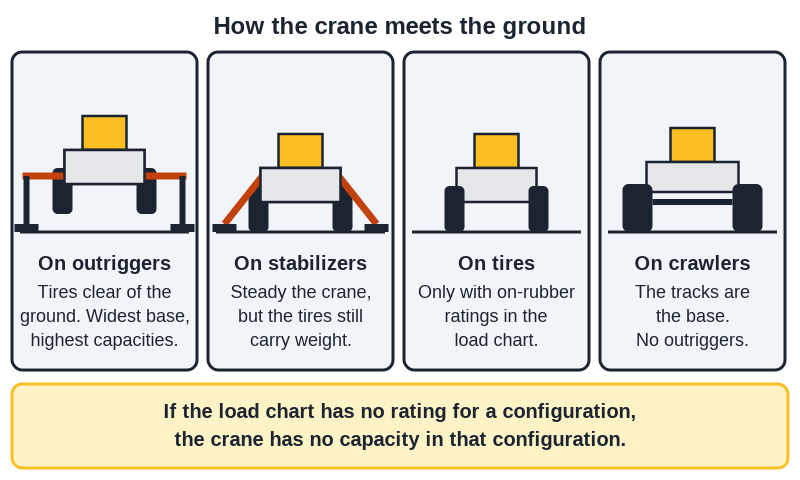
How the crane meets the ground changes what it may lift.
- On outriggers. Beams extend from the carrier and jacks lift the crane until the tires are clear of the ground. This gives the widest, most rigid base and the highest capacities.
- On stabilizers. Common on boom trucks. Stabilizers steady the crane but do not lift its whole weight off the tires. OSHA treats them differently from outriggers for that reason (1926.1404(q)).
- On tires ("on rubber"). Only if the manufacturer publishes on-rubber ratings, and only as that chart says: stationary, or pick and carry at creep speed with the boom in a stated position. Tire pressure must be what the manufacturer specifies.
- On crawlers. The tracks are the base. Some crawlers extend their tracks sideways for lifting, and the chart says which position applies.
If the load chart has no rating for a configuration, the crane has no capacity in that configuration.
Other cranes you will hear about
Articulating (knuckle boom) cranes, service truck cranes, tower cranes and overhead cranes are covered by OSHA's rules too, but they are certified separately and are not part of the Mobile Crane Operator program. According to the CCO candidate handbook, the fixed cab (TSS) certification also covers service truck cranes.
On the exam: Expect questions that describe a crane and ask what it is or how it may be used. Classic mistakes: assuming every crane may pick and carry (only if the chart gives ratings for it), assuming stabilizers are outriggers, and choosing the designation from the crane's name instead of from where the operator sits.
Key points
- Two boom families: telescopic (hydraulic) and lattice.
- Swing cab cranes (TLL): the cab rotates with the boom. Fixed cab cranes (TSS): the operator's station stays with the carrier.
- Rough terrain, all terrain and telescopic truck cranes are normally swing cab. Boom trucks and carry deck cranes are normally fixed cab.
- Crawler cranes ride on tracks and have no outriggers.
- Outriggers lift the crane's weight off the tires. Stabilizers do not.
- A crane may work on tires or pick and carry only where the manufacturer's chart gives ratings for it.