Your card is one of three things your employer must have in hand before you sit in the seat. The 2018 rewrite of OSHA 1926.1427 changed what the card means and added a documented evaluation that many operators have never seen on paper. The exam asks about both.
The rule in one sentence
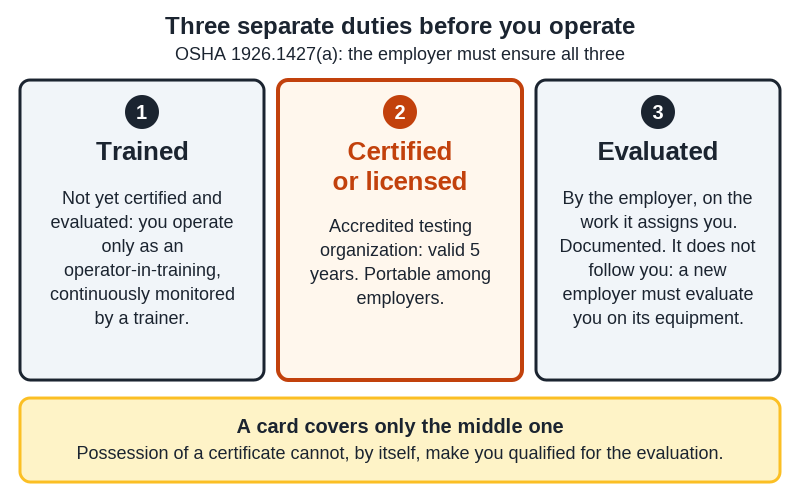
Under 1926.1427(a), the employer must ensure that each operator is trained, certified or licensed, and evaluated before operating equipment covered by Subpart CC. Three separate duties. A card covers only the middle one.
Watch the narrated video in the course portal.
The section does not apply to operators of derricks, sideboom cranes, or equipment rated 2,000 pounds or less (1926.1427(a)(2)). Those sections have their own training rules.
Certification and licensing: the options
| Route | Who issues it | Valid for | Portable? |
|---|---|---|---|
| State or local license | A government licensing office whose program meets 1926.1427(c)(1) | As the license says, no longer than 5 years | Within that jurisdiction |
| Accredited testing organization | For example NCCCO, accredited by a nationally recognized accrediting agency | 5 years (1926.1427(d)(4)) | Yes, among employers |
| Audited employer program | The employer, with tests developed or approved and audited by outside auditors | 5 years | No: only with that employer |
| U.S. military qualification | The military, for its own employees | As the military says | No |
Points the exam likes:
- Where a state or local government licenses operators, you need that license to operate in that jurisdiction, if the licensing program meets the rule's requirements. Certification is the route where there is no such license requirement (1926.1427(c)(2)).
- Certification is by equipment type, or type and capacity (1926.1427(d)(1)(ii)(B)). Under the original 2010 rule it had to be by type and capacity. The 2018 rule dropped the capacity requirement.
- The employer pays. Required certification or licensing must be provided at no cost to the employee (1926.1427(c)(3)).
- The written test must cover the controls and performance characteristics, load chart calculations on a variety of configurations, preventing and responding to power line contact, the Appendix C technical knowledge, ground and site hazards, and Subpart CC itself, plus the ability to find information in the manual (1926.1427(j)(1)). That list is a fair description of the CCO Core exam.
- The practical test must cover recognizing the shift inspection items, operating and maneuvering skills, applying load chart information, and safe shutdown and securing (1926.1427(j)(2)).
- Tests may be given in any language the candidate understands, and the certificate notes the language. The operator may then run only equipment whose manuals and load charts are in that language (1926.1427(h)(2)).
The employer's evaluation: the 2018 addition
The evaluation in 1926.1427(f) is the employer's own check that you can safely do the work it assigns you. It must show:
- the skills and knowledge to run the equipment safely, including its safety devices, operational aids, software, and its size and configuration (lifting capacity, boom length, attachments, luffing jib, counterweight set-up), and
- the ability to do the hoisting work you are assigned, including blind lifts, personnel hoisting and multi-crane lifts where they apply.
Rules about the evaluation:
- A certificate does not make you qualified for it. The rule says plainly that possession of a certificate or degree cannot, by itself, make a person qualified for this purpose (1926.1427(f)(3)).
- The evaluator must have the knowledge, training and experience to assess operators, and must be an employee or agent of the employer (1926.1427(f)(4), (5)).
- It must be documented: the operator's name, the evaluator's name and signature, the date, and the make, model and configuration of the equipment used. The document must be available at the worksite while you work for that employer (1926.1427(f)(6)).
- It carries over to similar equipment. Once evaluated, you may run other equipment that the employer can show does not require substantially different skills, knowledge or ability to recognize and avert risk (1926.1427(f)(5)).
- Operators employed before December 10, 2018 could be covered by the employer's earlier assessments instead of a new evaluation, documented the same way (1926.1427(f)(2), (6)).
- Retraining: if your performance or an evaluation of your knowledge shows retraining is needed, the employer must provide it, and must re-evaluate you on that subject (1926.1427(b)(5), (f)(7)).
So your CCO card follows you from job to job, and the evaluation does not. A new employer must evaluate you on its equipment.
Operators-in-training
An operator who is not yet certified and evaluated may operate only as an operator-in-training (1926.1427(a)(1), (b)):
- Continuously monitored by a trainer who is an employee or agent of the employer, has the knowledge and experience to direct the trainee, and does no other tasks that distract from monitoring.
- For mobile cranes, trainer and trainee are in direct line of sight and communicate by voice or hand signals.
- Breaks: no longer than 15 minutes, no more than one per hour, with the trainee told exactly what tasks to do meanwhile.
- Not allowed for a trainee: work where any part of the equipment, load line or load could get within 20 feet of a power line up to 350 kV (50 feet over 350 kV), hoisting personnel, multiple-equipment lifts, work over a shaft, cofferdam or in a tank farm, and multiple-lift rigging unless the trainer judges the trainee ready.
Where ASME B30.5 fits
ASME B30.5 is the national consensus standard for mobile and locomotive cranes. It covers construction, installation, inspection, testing, maintenance and operation, and it sets out the responsibilities of the people involved in a lift. Three things to know:
- OSHA is law; ASME is a standard. On a construction site, OSHA 1926 Subpart CC is the regulation. Subpart CC refers to ASME B30.5 in places. For example, 1926.1414 lets wire rope meet a section of ASME B30.5-2004. Where a contract, a state plan or an employer's program adopts ASME B30.5, it becomes a requirement on that job.
- They often say the same thing in different words. When both apply to your job and they differ, meeting both means meeting the stricter one.
- Know which is which on the exam. The CCO outline lists ASME B30.5, ASME B30.10 (hooks) and OSHA 1910.180 alongside Subpart CC. When a question names a standard, answer from that standard.
The current edition of ASME B30.5 and the crane manufacturer's manual always govern how a specific crane is operated and inspected. This kit names ASME requirements in its own words and does not quote the standard.
On the exam: Expect questions on who must be certified, how long certification lasts (5 years), whether it is portable (accredited testing organization: yes; audited employer program: no), what the employer's evaluation must cover and record, and what an operator-in-training may not do. The classic wrong answer is "a valid certification means the operator is qualified to run any crane of that type." It does not. The employer must still evaluate.
Key points
- Employer duty: every operator is trained, certified or licensed, and evaluated (1926.1427(a)).
- Accredited certification: 5 years, portable, by type or type and capacity. Audited employer program: 5 years, not portable.
- The documented evaluation records name, evaluator and signature, date, and the make, model and configuration used.
- A certificate alone does not make you qualified for the evaluation.
- Operators-in-training: continuous monitoring, line of sight, and no power line work within 20 feet, personnel hoisting or multi-crane lifts.
- OSHA Subpart CC is the law on construction sites; ASME B30.5 is the consensus standard for mobile cranes.