
Every sling and every piece of hardware carries a number that tells you how much you may put on it. Riggers who understand where that number comes from do not talk themselves into "a little over won't hurt."
Three terms
| Term | What it means | Also called |
|---|---|---|
| Rated load | The maximum load you are allowed to apply to the equipment, as set by its manufacturer and marked on it | Working load limit (WLL), rated capacity. Older gear and older rules say safe working load (SWL) |
| Breaking strength | The load at which the equipment, new and undamaged, breaks when pulled in a straight line in a test | Minimum breaking strength, minimum breaking force, ultimate strength |
| Design factor | Breaking strength divided by rated load | Older rules call it the safety factor |
OSHA defines safety factor the same way: the ratio of the ultimate breaking strength of a piece of equipment to its actual working stress or safe load when in use (29 CFR 1926.32).
The rated load is the only one of the three you work with. Breaking strength is a laboratory number for new gear. It is not a limit you are allowed to approach.
The arithmetic
Rated load = breaking strength ÷ design factor
Breaking strength = rated load × design factor
Example 1. A new wire rope sling has a minimum breaking strength of 25,000 lb in a straight pull. Wire rope slings use a design factor of 5.
Rated load = 25,000 ÷ 5 = 5,000 lb.
Example 2. An alloy chain sling is tagged with a rated load of 12,000 lb. Chain slings use a design factor of 4.
Minimum breaking strength = 12,000 × 4 = 48,000 lb.
Example 3. A web sling is tagged 6,400 lb vertical. A coworker says, "The design factor is 5, so it's really good for 32,000. We can pick 8,000 with it." That is wrong. The rated load is 6,400 lb, and 8,000 lb is 1,600 lb over it. The sling must not be used for that lift in a vertical hitch.
Design factors for slings
ASME B30.9, the sling standard, sets a minimum design factor for each kind of sling.
| Sling type | Design factor |
|---|---|
| Wire rope | 5 |
| Alloy steel chain | 4 |
| Metal mesh | 5 |
| Synthetic rope | 5 |
| Synthetic web | 5 |
| Synthetic roundsling | 5 |
One number to remember, with one exception: everything is 5 except chain, which is 4.
Why the design factor is not spare capacity
The gap between rated load and breaking strength is already spent. It covers things the rated load cannot predict:
- Wear. A sling in service is never as strong as the day it was made.
- Dynamic forces. Starting, stopping and swinging add force that a scale would not show.
- Small errors. A weight that is a little high, a sling angle a little flatter than planned.
- Conditions of use. The breaking strength was measured in a straight, steady pull on new gear. Bends, sharp edges, heat and chemicals all take strength away.
You cannot tell how much of the margin has been used up. That is why the rule is absolute.
The rules on rated load and marking
OSHA's construction rule for rigging equipment (29 CFR 1926.251) says rigging equipment must:
- have permanently affixed and legible identification markings, as prescribed by the manufacturer, that indicate the recommended safe working load,
- not be loaded in excess of that recommended safe working load, and
- not be used without affixed, legible identification markings.
The general industry sling rule (1910.184) says the same for slings: do not load a sling beyond its rated capacity, and do not use a sling without affixed and legible identification markings.
On the job this becomes a simple habit: no tag, no lift. If the tag is missing or you cannot read the rated load, the sling comes out of service. You do not guess its capacity from its size or its color.
The rated load depends on how the gear is used
The big number on a tag applies to one way of using the equipment. A sling's rated load changes with:
- The hitch. The same sling has different rated loads in a vertical, a choker and a basket hitch. Module 4 covers this.
- The sling angle. The flatter the sling, the more tension it carries for the same load. Module 5 covers this.
- What it bends around. A sling bent tightly over a small pin or a corner loses strength. Module 3 covers this.
Hardware is the same. A shackle or an eyebolt pulled at an angle has a lower rated load than the one stamped on it. Module 6 covers hardware.
The weakest link
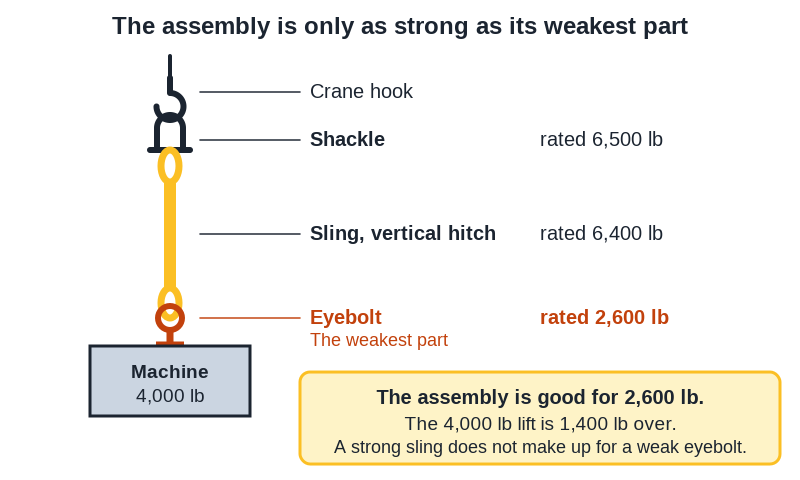
A rigging assembly is a chain of parts between the hook and the load: slings, shackles, eyebolts, a lifting beam. The assembly can carry only what its weakest part can carry, as that part is being used.
Example 4. A 4,000 lb machine is lifted with one sling in a vertical hitch. The sling is rated 6,400 lb vertical. The shackle at the top is rated 6,500 lb. The eyebolt on the machine is rated 2,600 lb.
The assembly is good for 2,600 lb, the rating of the eyebolt. The lift is 1,400 lb over. A strong sling does not make up for a weak eyebolt.
Watch the narrated video in the course portal.
Check the rated load of every part, each time.
Static load and dynamic load
A static load is a load at rest or moving steadily. Hanging still, a 5,000 lb load puts 5,000 lb on the rigging.
A dynamic load is the extra force caused by motion: jerking the load off the ground, stopping it suddenly, letting it swing. For a moment the rigging can feel far more than the load's weight. Rated loads assume the load is applied smoothly. Module 5 covers shock loading.
Which rule covers what
The exam draws on these sources. You are not asked for paragraph numbers, but you should know which document covers which equipment.
| Source | Covers |
|---|---|
| ASME B30.9 | Slings |
| ASME B30.10 | Hooks |
| ASME B30.26 | Rigging hardware: shackles, eyebolts, hoist rings, turnbuckles, clips, links, rings |
| ASME B30.20 | Below-the-hook lifting devices: lifting beams, spreader bars, clamps, magnets |
| ASME B30.5 | Mobile and locomotive cranes |
| OSHA 29 CFR 1926.251 | Rigging equipment for material handling, in construction |
| OSHA 29 CFR 1910.184 | Slings, in general industry |
In ASME standards the word shall means the requirement is mandatory, and should means it is a recommendation. OSHA rules are law. Above both sits the same practical rule: follow the manufacturer's instructions for the equipment in your hands, and use the current edition of the standard.
On the exam: Expect a calculation in one direction or the other: breaking strength and design factor given, find the rated load, or the reverse. Expect a question on what to do with a sling that has no tag (remove it from service), and one on which term means the maximum load allowed in service (rated load, or working load limit). The classic wrong answer treats the design factor as extra capacity.
Key points
- Rated load, working load limit and rated capacity mean the same thing: the most you may put on the gear.
- Rated load = breaking strength ÷ design factor.
- Sling design factors are 5, except alloy chain slings at 4.
- The design factor is not spare capacity. Never exceed the rated load.
- No legible tag or marking, no lift.
- An assembly is only as strong as its weakest part, as that part is used.