
Every number in a lift plan starts with the weight. If the weight is wrong, the sling tensions are wrong, the crane's percent of capacity is wrong, and nobody finds out until the load is in the air. A Level II rigger needs to establish a reliable weight and explain the dimensions and material data used to calculate it.
Where a load weight comes from
Use the best source you can get, in roughly this order:
- Shipping papers, a bill of lading, or a weight marked on the load or its nameplate.
- The manufacturer's data or engineered drawings.
- Weighing: a scale, a load cell, or the crane's load-indicating device.
- Calculation from measured dimensions and the material.
OSHA 1926.1417 puts it this way for cranes: the weight of the load must be determined from a source recognized by the industry, such as the load's manufacturer, or by a calculation method recognized by the industry, such as calculating a steel beam from measured dimensions and a known per-foot weight, or by other equally reliable means.
Calculation is what you do when the paperwork is missing, and it is also how you check paperwork that looks wrong. Equipment gets modified. Tanks get filled. A nameplate does not know about the 400 lb of piping someone added.
The basic formula
Weight = volume × unit weight
- Volume is how much space the material fills, in cubic feet.
- Unit weight is what one cubic foot of the material weighs.
For a box shape: volume = length × width × height, with all three in feet.
Unit weights to know
| Material | Pounds per cubic foot |
|---|---|
| Steel | 490 |
| Cast iron | 450 |
| Aluminum | 165 |
| Copper | 560 |
| Lead | 710 |
| Reinforced concrete | 150 |
| Water | 62.4 |
| Wood | 25 to 55, by species and moisture |
| Dry sand or gravel | 100 to 120 |
Memorize steel, aluminum, concrete and water. For wood, soil and anything else that varies, get the real figure for the job. If you must estimate, use the high end.
Get the units right first
Dimensions on a job come in feet and inches. The formula needs feet. Convert before you multiply.
| Inches | 1 | 2 | 3 | 4 | 6 | 8 | 9 |
|---|---|---|---|---|---|---|---|
| Feet | 1/12 | 1/6 | 0.25 | 1/3 | 0.5 | 2/3 | 0.75 |
Mixing inches and feet is the most common calculation error on the exam. A plate "4 by 8 by 1" is not 32 cubic feet.
Worked example: a concrete footing
A precast concrete footing is 6 ft long, 4 ft wide and 2 ft thick.
- Volume: 6 × 4 × 2 = 48 cubic feet.
- Weight: 48 × 150.
By hand, multiplying by 150 is "times 100, plus half again": 4,800 + 2,400 = 7,200 lb.
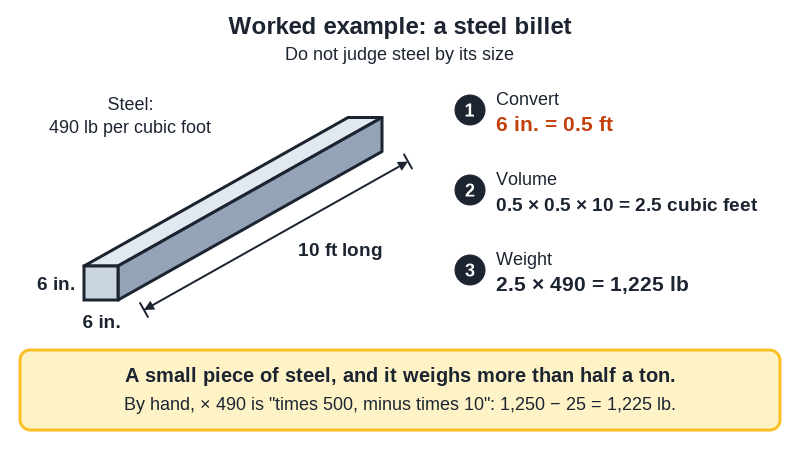
Worked example: a steel billet
A solid steel billet is 6 in. by 6 in. by 10 ft long.
- Convert: 6 in. = 0.5 ft.
- Volume: 0.5 × 0.5 × 10 = 2.5 cubic feet.
- Weight: 2.5 × 490.
By hand, multiplying by 490 is "times 500, minus times 10": 1,250 − 25 = 1,225 lb.
It is a small piece of steel, and it weighs more than half a ton. Steel is more than three times as heavy as concrete, and nearly eight times as heavy as water. Do not judge steel by its size.
The plate shortcut
Flat material is easier with a different unit: the weight of one square foot, one inch thick.
| Material | Pounds per square foot, per inch of thickness |
|---|---|
| Steel | 40.8 |
| Aluminum | 13.75, or about 14 |
| Concrete | 12.5 |
These are the unit weights divided by 12. For steel: 490 ÷ 12 = 40.8.
Plate weight = area in square feet × thickness in inches × pounds per square foot per inch
Example 1. A steel plate is 4 ft by 8 ft and 1/2 in. thick.
- Area: 4 × 8 = 32 square feet.
- Times thickness: 32 × 0.5 = 16.
- Times 40.8. By hand: 16 × 40 = 640, and 16 × 0.8 = 12.8. Total 652.8 lb, so call it 653 lb.
Example 2. A steel base plate is 5 ft by 10 ft and 2 in. thick.
- Area: 50 square feet.
- Times thickness: 50 × 2 = 100.
- Times 40.8: 4,080 lb.
Example 3. A concrete slab is 10 ft by 8 ft and 9 in. thick.
- Area: 80 square feet.
- Times thickness: 80 × 9 = 720.
- Times 12.5. By hand: 720 × 10 = 7,200, and 720 × 2.5 = 1,800. Total 9,000 lb.
Check it the long way: 80 square feet × 0.75 ft = 60 cubic feet, and 60 × 150 = 9,000 lb. Same answer, as it should be.
Stacks, bundles and structural shapes
Count and multiply. A bundle of 20 steel sheets, each 4 ft by 8 ft and 1/4 in. thick:
- One sheet: 32 × 0.25 = 8, and 8 × 40.8 = 326.4 lb.
- Twenty sheets: 326.4 × 20 = 6,528 lb.
A stack of thin sheet looks light, and this one weighs more than three tons.
Structural steel carries its weight in its name. For a wide-flange beam the second number in the size is the weight in pounds per foot. A W12×50 beam is about 12 in. deep and weighs 50 lb per foot. A 24 ft length weighs 24 × 50 = 1,200 lb. Pipe, angle, channel and rebar have per-foot weights too, in tables from the supplier or in a rigging handbook. That is the "known per-foot weight" OSHA mentions.
Find the material cross section
[[check: Before you rotate the pipe, predict the shape of its end wall. For a straight length with outside diameter D and inside diameter d, what must be subtracted?]] [[explain: Look end-on. The wall is an annulus: subtract the inner circular area from the outer area. The straight material volume is π × (D² − d²) × length ÷ 4. Use one unit system throughout, then multiply by the material’s unit weight.]]
In the course, an interactive exercise sits here. The outer surface surrounds a smaller inner surface. The open bore extends to the far end. The model also shows raised rims. Account separately for those features and any fittings, linings or contents on a real load.
Measure the real thing
A calculation is only as good as the tape measure.
- Measure the load yourself when you can. Do not trust a dimension someone remembers.
- Record the measured outside dimensions and any measured voids. Retain their precision during the calculation.
- Look for what makes the load heavier than its shape suggests: thick end plates, solid cores, counterweights, a motor at one end, liner plates, refractory, wet insulation.
- Ask what is inside. An "empty" vessel may hold product, water or sludge.
Round against yourself
Calculate with the verified dimensions and unit weight first, then round the resulting load weight upward for a conservative estimate. For example, 6,528 lb can be carried forward as 6,600 lb. With hollow pipe, rounding the inside diameter upward would subtract too much material and underestimate the weight. Verify uncertain dimensions or material against reliable load data before relying on the result.
On the exam it is different: work the numbers exactly as given and pick the option that matches. The options are far enough apart that small rounding will not change the answer.
Estimate before you calculate
Before you put pencil to paper, guess. A 4 by 8 steel plate one inch thick is 32 square feet at about 40 lb each: around 1,300 lb. Now calculate: 32 × 40.8 = 1,305.6 lb. The guess and the answer agree, so the decimal point is in the right place.
A second check is to compare with something you know. A cubic yard of concrete is 27 cubic feet: 27 × 150 = 4,050 lb, about two tons. If your number for a concrete block the size of a pickup bed is 900 lb, something is wrong.
On the exam: Practice with a steel plate, a concrete block and a beam listed in pounds per foot. The trap is nearly always units, with a thickness in inches sitting among dimensions in feet. Convert first, write the units beside every number, and check that your answer is sensible for the size of the object.
Key points
- Weight = volume × unit weight. Volume of a box = length × width × height, all in feet.
- Steel 490, aluminum 165, reinforced concrete 150, water 62.4 lb per cubic foot.
- Steel plate: 40.8 lb per square foot for each inch of thickness. Concrete: 12.5. Aluminum: about 14.
- Convert inches to feet before multiplying, or use the plate shortcut.
- By hand: × 150 is × 100 plus half. × 490 is × 500 minus × 10. × 40.8 is × 40 plus × 0.8.
- Structural shapes: pounds per foot × length.
- Round up in the field. Estimate first to catch decimal slips.