
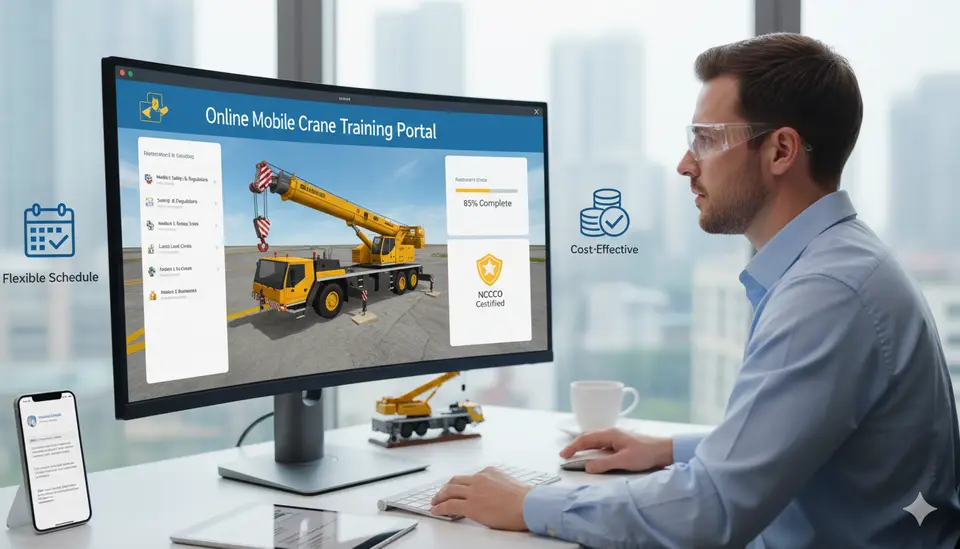
Start with how mobile crane certification is structured
Before comparing courses, it helps to know what they are preparing you for. NCCCO's mobile crane operator program has two written layers:
- The Core exam, which covers knowledge every mobile crane operator needs: site setup, operations, technical knowledge, load charts in general terms and OSHA regulations.
- One or more specialty exams, each built around a crane type and its load charts. The four mobile specialties are LBC (lattice boom crawler), LBT (lattice boom truck), TLL (telescopic boom, swing cab) and TSS (telescopic boom, fixed cab).
Each specialty you want on your card also requires a practical exam on that type of crane. Online courses address the written layers; the practical is earned at a test site. The NCCCO mobile crane overview describes the structure in more detail.
Four candidate profiles
Profile A: New to cranes
You may have worked around cranes as a laborer or oiler, but you have never been responsible for a lift. You need a course that teaches from the ground up: crane terminology, how stability works, what the load moment indicator does, how ground bearing pressure relates to outrigger pads. Load charts must be taught step by step with plenty of worked examples.
What to prioritize: depth of explanation, glossary support, module quizzes and a clear study sequence. Plan to spend serious time on the Core material before the specialty charts.
Profile B: Experienced but never certified
You have run cranes for years, perhaps for an employer that qualified you internally. Your operating knowledge is solid, but the exam asks things in its own way. Experienced candidates commonly trip on chart notes (what is and is not included in the listed capacity), deductions for hook blocks and rigging, and exact regulatory distances.
What to prioritize: timed practice exams with explanations, chart-reading drills and a fast way to skip what you already know.
Profile C: Certified, adding a specialty
You already hold Core and one specialty — say TSS from boom truck work — and now you need TLL or a lattice boom designation. You do not need to re-study Core. You need concentrated chart work for the new crane type.
What to prioritize: a specialty-focused module or track. Our TSS/TLL training and lattice boom prep are built for this profile.
Profile D: Renewing
Your card expires within the year. You need to pass the recertification written exam for each designation and document experience. You want a refresher on what has changed and the details that fade over five years.
What to prioritize: concise review, updated regulation content and practice questions. See the recertification prep course.
A course scorecard
Use this to compare any online mobile crane certification course. Score each line from 0 to 2.
| Question | 0 | 1 | 2 |
|---|---|---|---|
| Content mapped to current NCCCO outlines? | Not stated | Claimed | Shown by topic |
| Load chart instruction | Video only | Some examples | Worked problems you solve |
| Practice exams | None | Untimed quizzes | Timed, with explanations |
| Fits your profile (A–D) | Generic | Partly | Built for it |
| Support from someone who knows cranes | None | Email only | Phone and email |
| Access period | Short, fixed | Moderate | Long enough to pause and return |
| Clear about what it is not | Implies certification | Vague | States that exams are separate |
A course that scores low on the last line deserves extra suspicion. Any provider implying its course is the certification, or that it replaces the practical exam, misunderstands how the system works.
Cost factors to ask about
Prices vary widely, so compare total cost rather than the headline number:
- Course fee and what it includes (Core, specialties, practice tests)
- Whether practice tests are extra
- How long access lasts and whether extensions cost money
- Exam fees, which NCCCO and test sites charge separately from any course
- Seat time or practice crane rental for the practical
- Time away from work, if the option requires attendance
Common mistakes when picking a course
Buying for the wrong designation. Check with your employer whether you need TLL, TSS or a lattice boom specialty before you pay for anything. Studying swing-cab charts when your job is on a boom truck wastes weeks.
Choosing on length alone. A course with more hours is not automatically better. Profile B and C candidates in particular benefit from concise, targeted material.
Ignoring practice test quality. A large question bank full of trivia is less useful than a smaller set that mirrors the style of real chart and regulation questions and explains every answer.
Forgetting about the practical. The written exam is only half of certification. If you do not have regular seat time on the crane type you are testing for, plan it before you finish the course.
Waiting for the perfect moment. Most candidates do better with a target exam date than with open-ended study. Book a date that gives you a realistic runway and work backward.
For specialty-specific study habits, see our TSS/TLL exam preparation tips.
Online versus in-person for mobile crane prep
Self-paced online study suits Profiles B, C and D especially well because they already have seat time and need targeted knowledge review. Profile A candidates benefit from online study too, but should plan supervised operating practice before the practical — our practical training guide covers how people arrange it. Classroom courses help learners who need a set schedule and live discussion, at the cost of travel and fixed dates.
Making the decision
Pick your profile, run two or three courses through the scorecard and choose the one that fits rather than the one with the longest feature list. Then commit: steady study, practice tests until your scores are consistently strong, and a booked exam date to keep you honest. If you are in Profile A or B, the mobile crane certification prep course is the natural starting point.