
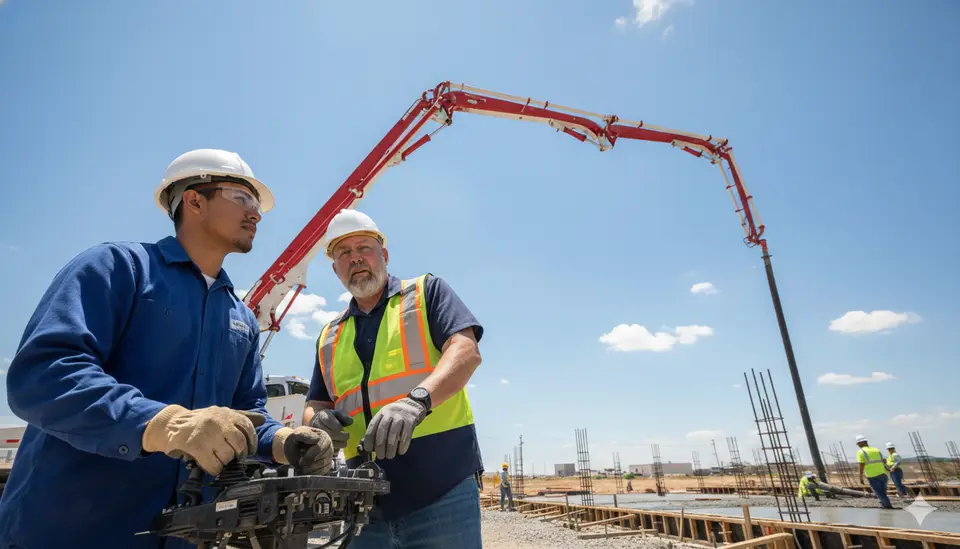
Every pour has a deadline. Ready-mix trucks are lined up, finishers are waiting, and the concrete starts setting the moment it leaves the plant. The person at the center of that schedule is often the pump operator, who sets up the machine, unfolds the boom and places concrete exactly where the crew needs it.
It is skilled, demanding work, and it rewards people who like machines, responsibility and being outdoors. Here is a realistic path into the trade.
Step 1: Understand What the Job Involves
Concrete pump operators work with two main kinds of equipment:
- Boom pumps are truck-mounted machines with a folding, articulating boom that carries the delivery line. They handle large pours, elevated decks and sites where reach matters.
- Line pumps (also called trailer pumps) push concrete through hoses or steel pipe laid across the site. They are common on smaller residential and commercial jobs.
A typical day includes driving to the site, checking ground conditions, setting outriggers, unfolding the boom, coordinating with the ready-mix drivers and finishers, pumping the pour, then cleaning out the hopper and lines. Operators also handle daily inspections and basic maintenance.
The work is physical and weather-dependent, starts early, and depends heavily on communication. If you enjoy problem-solving under time pressure, it can be very satisfying.
Step 2: Build a Safety Foundation
Before anyone hands you the remote for a boom, you need to be safe around a construction site. Many entry-level workers start with general construction safety training, such as OSHA 10-Hour Construction Safety, which covers hazards like falls, struck-by incidents and electrical exposure.
Pumping crews also benefit from understanding hand signals, since the operator often relies on a spotter at the end of the hose. Our signal person training covers standard signals used around cranes and booms.
Step 3: Get Your Foot in the Door
Most operators did not start as operators. Common entry points include:
- Hose hand or pump laborer, guiding the end hose, setting up line and helping with cleanout
- Line pump operator, a common first step before moving up to boom pumps
- Ready-mix driver or general construction laborer who moves into pumping
Pumping companies often train promising helpers in-house. Time on the end hose teaches you how concrete behaves, how pours are sequenced and what an operator needs from the crew, all of which make you a better operator later.
Step 4: Check Driver Licensing Requirements
Many boom pumps are large trucks, and operators frequently drive them between the yard and job sites. Depending on the truck's weight rating and your state, that can require a commercial driver's license (CDL). Requirements vary by vehicle and employer, so ask prospective employers what they expect and check your state's motor vehicle agency for the rules.
Step 5: Learn the Technical Knowledge
As you gain experience, start studying the material that operators are expected to know and that certification exams test:
- ASME B30.27, the safety standard for material placement systems such as concrete pump booms
- Outrigger setup, ground bearing pressure and cribbing
- Boom configurations, reach limits and the manufacturer's operating restrictions
- Power line hazards and safe clearance practices
- Hose whip, blockages, and pressure-related hazards
- Daily, frequent and periodic inspection requirements
Our concrete pump training course is self-paced written-exam prep that organizes these topics into lessons with practice questions, so you can study between pours.
Step 6: Earn Your Certification
NCCCO offers a Concrete Pump Operator certification. Like other NCCCO programs, it involves a written exam and a practical exam on the equipment, and candidates must meet NCCCO's eligibility requirements, including age and policy requirements published in its Candidate Handbook. Our NCCCO concrete pump certification overview explains the structure in more detail.
Certification is not always required by law for concrete pumps, but many general contractors, owners and pumping companies expect it. A recognized credential also makes it easier to move between employers or regions.
A sensible sequence:
- Gain supervised experience running a pump under an experienced operator.
- Study for the written exam until your practice scores are consistently strong.
- Pass the written exam at a test center.
- Take the practical exam on a pump, demonstrating setup, operation and shutdown.
Step 7: Keep Growing After Certification
NCCCO certifications are valid for five years, so mark your expiration date and plan recertification early. Our guide to renewing your certification online walks through the timeline.
Beyond recertification, operators grow by:
- Moving up to longer booms and more complex pours
- Learning the mechanical side well enough to troubleshoot hydraulics and wear parts
- Adding related credentials, such as crane or rigging certifications, for broader construction roles
- Training newer hose hands and line pump operators
Some experienced operators move into dispatch, fleet management, safety or training roles. Others go on to run their own pumping businesses.
Skills That Set Good Operators Apart
- Spatial awareness: judging boom position relative to structures, power lines and people
- Calm communication: coordinating with finishers, drivers and spotters during a fast pour
- Mechanical sense: noticing a change in pump sound or pressure before it becomes a blockage
- Discipline with setup: never shortcutting outriggers or cribbing, even on a rushed job
For a deeper technical look at setup, blockages, power lines and washout, read our companion piece, the ultimate guide to concrete pump operator skills and safety.
Getting Started
If you are already on a pumping crew, start studying now; the knowledge will make you more valuable long before you test. If you are outside the industry, look for laborer or hose hand roles with pumping companies, and build your safety training alongside. Questions about our concrete pump prep course? Call The Online Crane School at (307) 355-0865.