
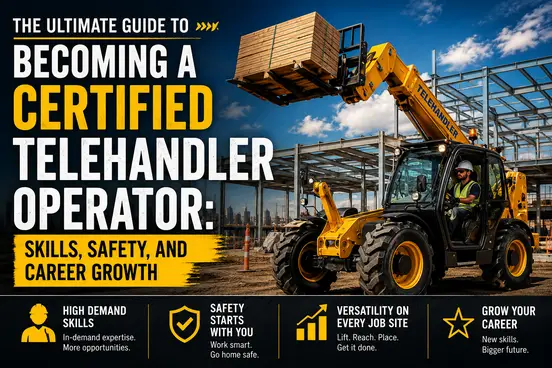
On a busy commercial site the telehandler is usually the machine that never stops. It carries pallets of block across mud, places trusses on a wall plate and lifts roofing bundles above scaffolding that a straight-mast forklift could never reach. That reach is the whole point of the machine, and it is also the reason so many telehandler incidents end in a tip-over.
This guide covers the mechanics, the stability rules and the regulatory twist that makes telehandlers unusual, then looks at the formal credentials available to operators.
What makes a telehandler different
A telehandler sits on a four-wheel-drive chassis with large off-road tires. The boom pivots near the rear of the frame and telescopes forward, so the engine and rear chassis work as counterweight when a load goes out front.
At the boom tip is a quick-attach carriage. Forks are the most common tool, but operators also run buckets, truss booms, lifting jibs and, on suitably rated machines, work platforms. Each attachment changes what the machine can safely carry, and most come with their own load chart.
Steering is the other distinctive feature. Many machines offer:
- Front-wheel steer for travel.
- Four-wheel (round) steer for tight turns.
- Crab steer, where all wheels point the same way so the machine can move diagonally and slide alongside a wall.
The stability triangle
The most important idea for a telehandler operator is the stability triangle. The front axle is fixed to the frame, while the rear axle oscillates on a central pin. That gives the machine three effective support points: the two front wheels and the rear pivot. The combined center of gravity of machine plus load must stay inside that triangle.
With the boom down and no load, the center of gravity sits toward the rear. Raise and extend the boom with a load on the forks and it moves forward toward the front axle. Push it past the axle line and the rear wheels lift; the machine tips forward. That is a longitudinal tip.
A lateral tip happens when the combined center of gravity moves outside the sides of the triangle, often because the operator is travelling across a slope or turning sharply with a raised load. The higher the load, the less sideways margin remains. Travelling with the boom low and the load just off the ground is a habit, not a suggestion.
On slopes, keep the heavy end uphill: with a load, the load faces uphill; empty, the rear of the machine does.
Reading the load chart
Telehandler charts look nothing like a mobile crane's radius table. Most are a curved grid that plots boom angle against boom extension, with extension usually marked by letters or colored indicators on the boom sections. Capacity zones are drawn across that grid.
To use it, find where the planned boom angle and the planned extension intersect, then read the zone. If the load weighs more than that zone allows, the lift does not happen as planned: move the machine closer, lower the placement height or choose different equipment. The general rule is simple: capacity drops quickly as reach increases.
Machines with outriggers (stabilizers) normally carry separate charts for working on tires and working on stabilizers, and attachments have their own charts too. Picking the wrong chart is one of the most common ways operators get into trouble, and it is a favorite exam topic. The practice test library lets you rehearse that chart selection before test day.
Hazards worth respecting
- Power lines. A telescoping boom can reach overhead conductors quickly. Plan the work to keep the boom and load well away from lines and know what to do if contact occurs.
- Ground conditions. Loaded front tires or stabilizer pads put high pressure on the ground. Soft fill and trench edges can collapse.
- Blind spots. The boom usually sits on one side of the cab and blocks a large part of the view. When you cannot see your path, stop and use a spotter. Our signal person training course is useful for the ground crew who guide these machines.
Forklift or crane? The OSHA question
Here is the regulatory twist. Fitted with forks, a telehandler is generally treated as a powered industrial truck. Operators of those trucks must be trained and evaluated under OSHA's powered industrial truck rule, 29 CFR 1910.178, which the construction standard also points to.
Change the configuration and the picture can change. OSHA's cranes and derricks standard for construction (29 CFR 1926 Subpart CC) excludes forklifts in general, but that exclusion does not apply when the machine is set up to hoist and lower a load with a winch or hook and move it horizontally while it is suspended. In that configuration the crane rules, including operator certification, can come into play. Because the details depend on the attachment and the task, confirm with your employer or check the standard at osha.gov before assuming either rule applies.
That ambiguity is one reason many contractors prefer operators who hold a recognized telehandler credential from the start.
Certification options
Two widely recognized routes exist:
- NCCCO Telehandler Operator certification, which pairs a written exam with a practical exam. See our NCCCO telehandler overview.
- NCCER telehandler credentials, delivered through NCCER's assessment network. Our NCCER telehandler overview explains how that path works.
Both test chart reading, stability, inspection and safe operating practice. Neither can be completed entirely online; the practical portion takes place on a real machine.
The walkaround
A daily pre-use inspection catches most problems before they become incidents. A thorough check covers:
- Tires: cuts, inflation, missing lug nuts.
- Hydraulics: leaking hoses, weeping cylinder seals, fluid levels.
- Boom: cracked welds near pivot pins and worn slide pads between sections.
- Forks and carriage: bent tines, heel cracks, locked attachment pins.
- Safety devices, gauges and the correct load charts in the cab.
Anything defective gets reported and the machine is tagged out until it is repaired.
Where online study fits
Load charts, stability theory and regulations are exactly the kind of material that rewards repetition. A self-paced telehandler training course lets you work through those topics in short sessions and return to the hard parts as often as you like. Pair that with supervised seat time and you will arrive at the practical exam ready.
If you also run cranes or plan to, our article on what a mobile crane operator career involves shows how telehandler skills carry over.