
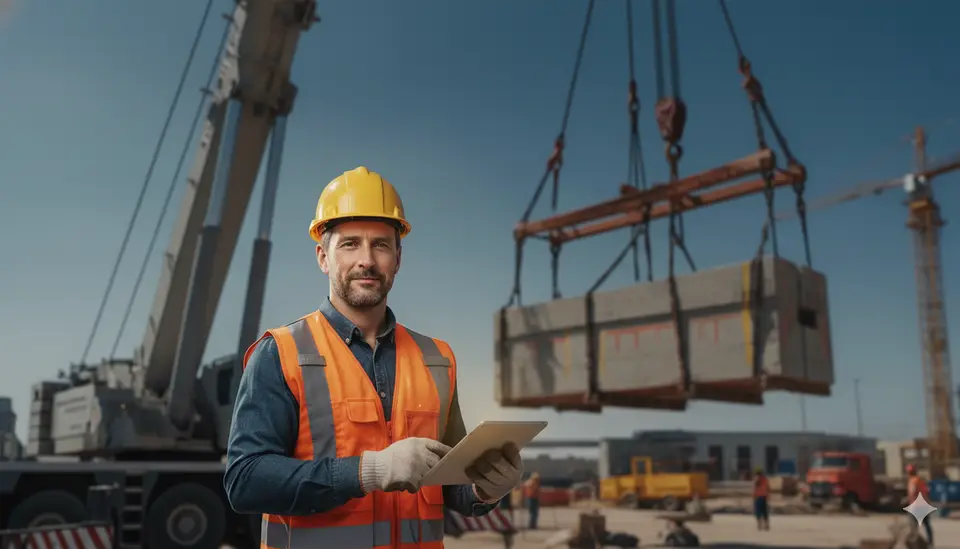
A crane can be perfectly set up, inspected and operated, and still drop its load because a sling was choked at the wrong angle or a shackle was side-loaded. Rigging is where many lifts are really decided. That makes rigging competence a shared concern: the operator wants to trust what is on the hook, and the employer carries the liability if something goes wrong.
Formal certification, typically NCCCO or NCCER Rigger Level I or Level II, is one way to make that competence visible. Below are five benefits, each looked at from the operator's side and the employer's side.
1. Fewer surprises on the hook
For the operator
When you understand rigging yourself, you recognize problems before you take the load: a basket hitch on a load that can shift, sling legs too flat for their rating, a hook latch missing, a synthetic sling with cuts or heat damage. OSHA expects operators to stop when they have safety concerns, and rigging knowledge gives you specific, defensible reasons to do so.
For the employer
Certified riggers bring a consistent approach to pre-lift checks: estimate the weight, find the center of gravity, choose a hitch, check capacities, inspect hardware. Consistency is what turns good intentions into fewer incidents. It also reduces the dependence on one experienced person who "just knows."
2. Portable proof of skill
For the operator
A rigger certification is a credential you own. It goes with you from contractor to contractor and from state to state, and it says something specific: you passed a standardized written exam and a hands-on practical. That is easier to verify than a résumé line reading "experienced rigger." Combined with an operator certification, it makes you a stronger candidate for crews where the operator is expected to understand the whole lift.
For the employer
Hiring someone with a recognized certification shortens the guesswork in onboarding. You still evaluate them on your equipment and your procedures, but you start from a known baseline.
3. Cleaner compliance records
OSHA's construction crane standard calls for qualified riggers during assembly and disassembly and in certain hooking and unhooking situations (29 CFR 1926.1404 and 1926.1425). OSHA does not require that riggers be certified, and the employer decides who is qualified. Even so, a current third-party certification is clear, dated documentation that supports that decision.
For the operator, holding the card means less explaining. For the employer, it means a tidy answer when an inspector, insurer or project owner asks how rigging competence was established. Some projects and owners specify rigger certification in their contracts; check the documents for each job.
4. Deeper technical skill
For the operator
Preparing for a rigging exam fills in knowledge many people pick up only partially on the job:
- How sling tension rises as the angle between the leg and the horizontal decreases.
- How choker and basket hitches change a sling's rated capacity.
- Inspection and removal criteria for slings (ASME B30.9) and hardware (ASME B30.26).
- Load weight estimation from dimensions and material.
- Center of gravity and how to keep a load level and stable.
Level II goes further into calculations, multi-leg rigging and load control. Our Rigger Level 2 course covers that ground.
For the employer
Workers who understand why a practice is required are more likely to follow it when nobody is watching, and better able to adapt when a lift does not match the plan. That is the difference between a crew that follows a checklist and a crew that can think through a problem.
5. A stronger company reputation and better bids
Owners and general contractors increasingly look at the qualifications of subcontractor crews. A roster of certified riggers and operators supports safety prequalification questionnaires and bid packages, and signals professionalism to clients. It can also feed into conversations with insurers, though how any carrier weighs certification is up to that carrier.
For the operator, being part of a certified crew means working for a company that takes lifting seriously, which is usually a better place to work.
Which rigging certification first?
- Rigger Level I suits workers who rig routine loads under direction and inspect gear. Start with our Rigger Level 1 course or the NCCCO Rigger Level I overview.
- Rigger Level II suits experienced riggers who plan and select rigging on their own. See the NCCCO Rigger Level II overview.
- Signalperson often goes hand in hand with rigging and is a sensible addition for anyone directing loads.
Employers training several people at once may find our rigging and hoisting company program a useful starting point.
How the certification process works
Both NCCCO and NCCER rigging programs combine a written exam with a practical exam. You can prepare for the written exam online at your own pace, but the practical has to be taken in person. Certifications must be renewed; NCCCO's are valid for five years.
The short version
Rigging certification gives operators a portable credential and better judgement at the hook. It gives employers consistent practices, clearer documentation and a stronger story for clients. For a detailed breakdown of the credentials themselves, read our guide to lifting and rigging certification online.