
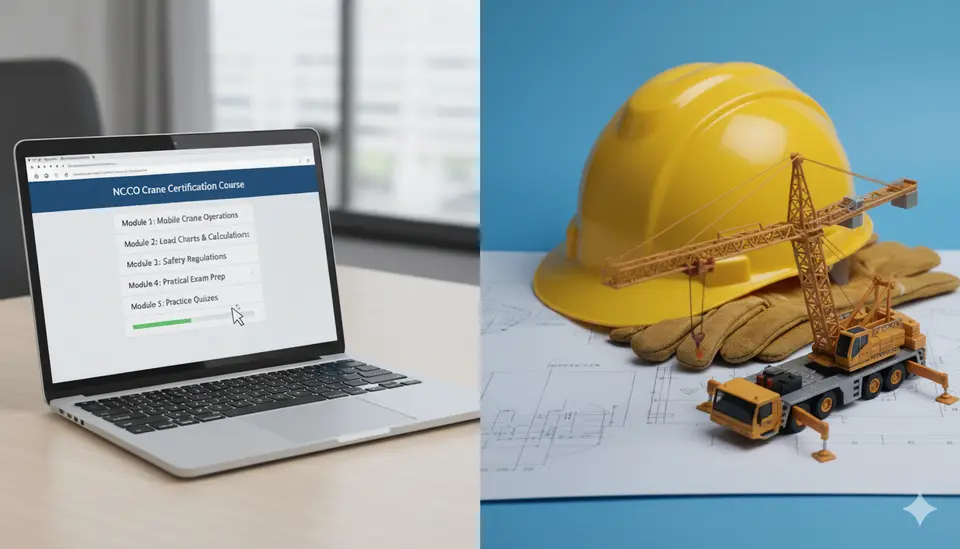
NCCCO certification has two parts: written exams (a Core exam plus at least one specialty for mobile cranes) and a hands-on practical. Prep courses mostly target the written side, and they come in several very different shapes. Rankings of named providers go out of date quickly and rarely match your situation. A better approach is to understand the formats, decide which fits you, and then judge individual providers against a checklist.
The five common formats
1. Self-paced online courses
Video lessons, reading, quizzes and practice exams that you work through on your own schedule.
- Good for: Working operators, people on rotating shifts, anyone who wants to replay load chart lessons until they click.
- Trade-offs: You set the pace, so motivation matters. There is no seat time.
- Look for: Coverage of the full Core outline plus your specialty, worked chart problems and enough access time to finish without rushing.
This is the format our own online crane courses use, including the mobile crane prep course and the TSS/TLL training.
2. Live virtual classes
An instructor teaches over video at scheduled times, often across several days or evenings.
- Good for: Learners who want to ask questions as they go and like a fixed schedule to keep them on track.
- Trade-offs: Sessions may clash with work. Missing one can leave a gap unless recordings are available.
- Look for: Small enough groups to get questions answered, and practice materials you can use between sessions.
3. In-person classroom courses
Traditional multi-day classes, frequently scheduled just before an on-site written exam session.
- Good for: Crews training together and people who learn best face to face.
- Trade-offs: Travel, time off work and a pace set by the group. Cramming several days of material can be hard to retain.
- Look for: Clarity on whether exam fees are included and how much time is spent on load charts.
4. Hybrid courses with seat time
Online or classroom theory combined with supervised hands-on practice on a crane, sometimes ending with the practical exam.
- Good for: Newer operators who lack regular access to a machine and need to build practical skill.
- Trade-offs: Typically the most expensive and the least flexible format, and availability depends on location.
- Look for: How many hours of actual seat time are included and which crane types are available. Our practical training explainer covers what to expect.
5. Practice-test-only packages
Banks of exam-style questions without full lessons.
- Good for: Experienced operators or recertification candidates who know the material and want to check readiness.
- Trade-offs: Practice questions show what you do not know but do not teach it. Memorizing answers is not learning.
- Look for: Explanations for every answer and questions that cover load charts, not just regulations. Our CCO practice tests fall into this category.
Side-by-side summary
| Format | Flexibility | Instructor access | Seat time | Typical time away from work |
|---|---|---|---|---|
| Self-paced online | High | Varies by provider | None | Minimal |
| Live virtual | Medium | High | None | Scheduled sessions |
| Classroom | Low | High | Rarely | Several days |
| Hybrid with seat time | Low | High | Yes | Several days or more |
| Practice tests only | High | Usually none | None | Minimal |
Cost factors to ask about
Prices vary widely and change often, so instead of comparing headline numbers, ask each provider:
- Are NCCCO exam fees included? Training fees and certification exam fees are usually separate. Exam fees are set by NCCCO and its test administrators.
- Is the practical exam included or arranged? If not, budget for booking one at a test site; our test site finder can help.
- How long does access last? Short access windows can force you to rush.
- Are practice tests included or extra?
- What about retakes? Know what it would cost to retest if you need to.
- What do travel and lost work time add? For in-person options, these can outweigh tuition.
A checklist for judging any provider
- The course follows the current NCCCO content outlines for the Core and your specialty.
- Load charts get serious time, with step-by-step worked examples.
- The provider is clear that it prepares you for NCCCO exams and does not claim to issue NCCCO certification.
- Claims are verifiable. Be cautious of unverifiable pass rates or guaranteed results.
- You can reach a person with questions. Ours is (307) 355-0865.
- Materials are usable on the devices you actually have.
Matching format to situation
- Working operator with crane access: self-paced online plus practice tests, then book the practical.
- Newcomer with no seat time: a hybrid program, or online theory plus employer-arranged supervised practice.
- Company certifying a crew: self-paced online so each person studies around their schedule, with group practical sessions arranged through a test site.
- Recertifying operator: a recertification course or practice-test package to refresh weak areas.
How long should preparation take?
There is no fixed answer. Experienced operators refreshing their knowledge may need only a few focused weeks; newcomers learning load charts from scratch usually need longer. Whatever the format, steady short sessions beat last-minute cramming.
Final thought
The best prep is the one you will actually finish, that covers the full exam outline and that leaves you comfortable with load charts. Pick the format that matches your schedule and experience, then hold any provider to the checklist above. For study techniques once you have chosen, see our NCCCO test preparation tips.