
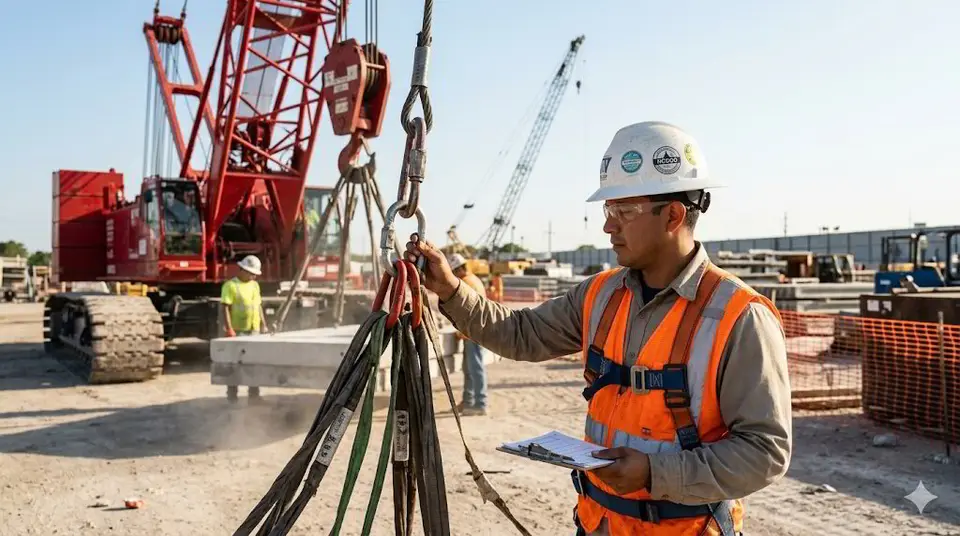
What a Level 1 rigger is trusted to do
Rigging credentials are tiered by responsibility. A Level I rigger is generally expected to handle routine rigging: inspecting gear before use, selecting the right sling and hitch for a simple lift when the load weight and plan are given, attaching and detaching loads correctly, and recognizing when something is wrong. A Level II rigger takes on non-routine work, including estimating weight and center of gravity and choosing rigging without that information being supplied.
Think of Level I as the credential for reliable execution. It does not ask you to engineer the lift; it asks you to rig it correctly and spot problems.
Why crane operators add it
An operator is responsible for the lift once it leaves the ground, but the rigging determines whether it leaves the ground safely. Operators with rigging knowledge are better at:
- Spotting an under-rated sling or a wrongly oriented shackle before the hook goes up
- Questioning a sling angle that looks too flat
- Accounting for rigging weight in capacity checks
- Talking to the crew in the same language
On smaller jobs, the operator may also be the one doing the rigging. A credential documents that skill to employers who ask for it. It also lays groundwork for later steps such as Rigger Level II or lift director.
Is it required?
OSHA's construction crane rules require a qualified rigger for assembly and disassembly work and for hooking and unhooking when workers are in the fall zone (29 CFR 1926.1404 and 1926.1425). OSHA leaves the qualification decision to the employer and does not require third-party certification. Many contractors, project owners and industrial sites, though, set their own policy requiring certified riggers. Check what your employer and projects expect.
Who offers it
Two of the best-known certifying bodies offer a Level I rigging credential:
- NCCCO offers Rigger Level I with a written exam and a practical exam. Read the NCCCO Rigger Level I overview for eligibility and structure.
- NCCER offers rigging credentials through its own assessment and performance verification. See the NCCER Rigger Level I overview.
Both are recognized in the industry. Your choice often comes down to what your employer or region prefers.
What the written exam covers
Expect content along these lines (confirm with the current outline from your certifying body):
- Rigging hardware: identification, use and inspection of shackles, hooks, eyebolts, turnbuckles, wire rope clips and below-the-hook devices
- Slings: wire rope, chain, synthetic web and round slings; tag information; removal criteria
- Hitches: vertical, choker and basket, and how each affects capacity
- Sling angles: why lower angles increase tension
- Load control: tag lines, landing loads, cribbing and blocking
- Signals: standard hand signals and voice communication
- Standards and regulations: ASME B30.9 and B30.26 basics, and the OSHA rules above
What the practical exam looks like
The practical tests whether you can apply that knowledge with real gear. Typically you will be asked to identify and inspect rigging components, choose suitable rigging for a described load, demonstrate hitches and attachment, and use signals correctly, while working safely throughout. Examiners pay attention to method and safety habits, not speed.
A preparation plan that fits around work
- Get the handbook. Download the candidate handbook and content outline from your certifying body.
- Learn the hardware. Go through your company's rigging loft with the outline in hand and name every item. Note inspection points.
- Study the concepts. Work through hitches, angles and capacity tables until you can explain them simply.
- Practice signals. Rehearse the standard hand signals until they are automatic.
- Rig real loads. Ask an experienced rigger to watch you rig and critique your choices.
- Take practice questions. Use exam-style questions, review your misses, and repeat.
A self-paced course is helpful for steps 3 and 6. Our Rigger Level 1 exam prep course covers the written content, and the Rigger Level I certification prep in our store is the enrollment option. If your employer qualifies riggers internally instead, the Rigger Level I qualification course may suit you better.
Common stumbling points
- Hitch reductions. Candidates forget that a choker hitch has a lower rating than a vertical one.
- Angle intuition. Many underestimate how quickly tension rises as slings flatten.
- Inspection specifics. Knowing that a sling "looks bad" is not enough; learn the specific removal criteria.
- Signal accuracy. Sloppy or improvised signals cost points on the practical.
A quick self-check
Before booking your exam, see whether you can answer these without notes:
- What information must appear on a synthetic web sling's identification tag?
- Why should a shackle pin not bear against a moving sling eye?
- How does a choker hitch's rating compare with the same sling in a vertical hitch, and where do you find the exact figure?
- What happens to the tension in each leg of a two-leg bridle as the angle from horizontal drops from 60 to 30 degrees?
- Which hand signal means emergency stop?
If any answer is vague, return to that topic. These are the kinds of concepts that both the written and practical exams probe.
Keeping the card
NCCCO rigging certifications are valid for five years. Plan your renewal before the expiry date, and keep a record of your rigging work. For an overview of how renewals work across NCCCO programs, read about NCCCO recertification requirements.
Is Level I enough?
For many operators, yes. It gives you the knowledge to check the rigging on your hook and to rig routine lifts yourself. If you find yourself planning lifts, estimating weights or supervising rigging crews, Level II is the logical next step. Our comparison of rigger certification online courses can help you decide when to move up.