
A lattice boom looks rugged. It is not. It is a light structure designed to carry one kind of load very well and almost nothing else. Operators who understand that do not side load booms, do not ignore a bent lacing and do not let anyone "fix" a boom with a torch.
Chords and lacings
Every lattice boom section is built from two kinds of members:
- Chords are the four main members that run the length of the section, one at each corner. They are high-strength steel, usually tube or angle.
- Lacings (also called lattices or lacing members) are the smaller members that zigzag between the chords.
When the crane lifts, the boom is squeezed end to end. That squeeze is called compression, and the chords carry it. A long, thin member in compression wants to bow sideways and buckle, the way a yardstick does when you push on its ends. The lacings stop that. They hold each chord straight and hold the four chords the right distance apart.
So the two kinds of members depend on each other. A chord with a dent, or a lacing that is bent or cracked, means a chord that is no longer fully supported. The boom can then buckle at a load well below the chart value, and it gives little warning.
What that means for you:
- Look at chords and lacings every time the boom is on the ground and as far as you can see during the shift inspection. Look for bends, dents, cracks, corrosion and damaged welds.
- If you find damage, stop and report it. A qualified person compares it with the manufacturer's criteria. The limits for chord damage are very tight, and the manual decides, not your eye.
- Never heat, straighten or weld a boom member in the field. Boom steel gets its strength from heat treatment, and heat from a torch or welder can destroy it. Repairs follow the manufacturer's procedure only.
What a lattice boom cannot take: side load
A lattice boom is designed for loads that act in the vertical plane of the boom, straight down under the boom tip. A force that pushes or pulls the tip sideways is a side load. A long boom has very little strength in that direction.
Side loads come from:
- A crane that is not level, so the load hangs to one side of the boom
- Dragging or pulling a load sideways, which OSHA 1926.1417(q) prohibits
- Swinging too fast, or starting and stopping the swing sharply
- Wind on the load and on the boom
- A load that is not directly under the boom tip when it is lifted
The longer the boom, the less side load it tolerates. Keep the load line plumb.
Boom sections
A lattice boom is assembled from sections pinned end to end.
| Section | Other names | What it does |
|---|---|---|
| Base | Butt, heel, boom foot section | Pins to the upperworks at the boom foot pins (heel pins). The boom pivots here. |
| Inserts | Extensions, intermediate sections | Add length. Made in set lengths, commonly 10, 20 and 40 ft. |
| Top | Tip, point, head section | Carries the boom point sheaves that the load line runs over. The pendants attach here. |
Sections join with connecting pins, usually four at each joint: two top pins and two bottom pins, named for their position when the boom is lying horizontal. Each pin is held in by a retainer such as a cotter pin or keeper. Remember the words "top pins" and "bottom pins". The OSHA rules for taking a boom apart in Module 3 depend on them.
Boom length and boom angle
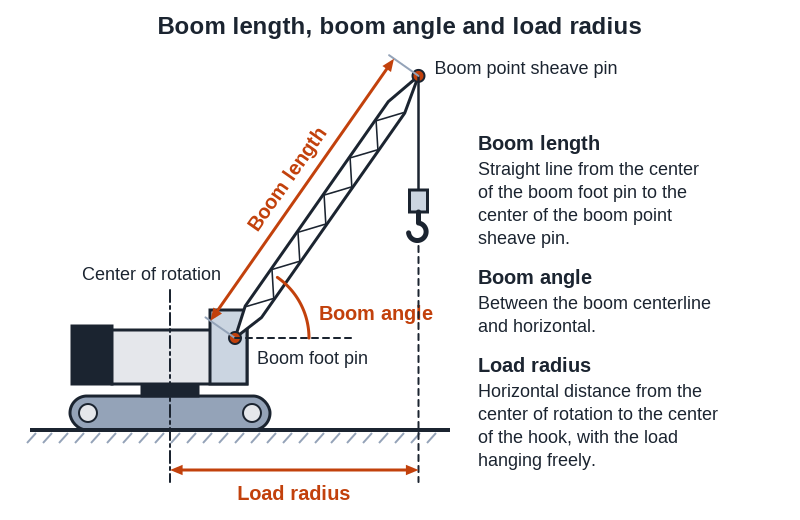
- Boom length is measured in a straight line from the center of the boom foot pin to the center of the boom point sheave pin.
- Boom angle is the angle between that boom centerline and horizontal. A boom lying flat is at 0 degrees. A boom pointing straight up would be at 90 degrees.
- Load radius is the horizontal distance from the crane's center of rotation to the center of the hook with the load hanging freely.
For one boom length, a higher boom angle means a shorter radius, and a lower boom angle means a longer radius.
Making up a boom: a worked example
You cannot pick any mix of inserts. The manufacturer's boom make-up chart (boom assembly chart) lists which inserts to use for each boom length and the order to pin them in. The order matters because sections are not all built to the same strength, and the pendants have to match.
Suppose a crane has a 20 ft base and a 30 ft top, and the lift plan calls for 150 ft of boom.
- Base plus top: 20 + 30 = 50 ft
- Inserts needed: 150 − 50 = 100 ft
- One way to get 100 ft: 40 + 40 + 20
Whether that is two 40s and a 20, or some other set, and where the 20 goes, comes from the make-up chart and nowhere else. OSHA 1926.1404(m) requires the selection of components and the configuration of the crane to follow the manufacturer's instructions, limitations and specifications.
After any change in boom length, three other things change with it: the load chart you use, the pendants in the boom suspension, and often the number of parts of line you can reeve. Module 5 deals with the chart side.
Other parts on the boom
| Part | What it is |
|---|---|
| Boom point sheaves | The sheaves at the tip that carry the main load line. |
| Auxiliary sheave | A single sheave on a short extension at the tip for the whip line. Also called a tip extension or rooster sheave. |
| Wire rope guides and rollers | Keep the load line off the boom structure. |
| Boom angle indicator | Shows the boom angle. OSHA defines it as a device that measures the angle of the boom relative to horizontal. |
| Hook block | The lower block on the main load line, with one or more sheaves. |
| Overhaul ball | The weighted ball and hook on a single-part whip line. Its weight pulls the line down when there is no load. |
On the exam: Know the names. A question may describe damage, such as a bent lacing near mid-boom, and ask what the operator should do. The answer is always to stop, report it and have it evaluated against the manufacturer's criteria, never to straighten it or keep working at reduced load on your own judgment. Also expect the definitions of boom length, boom angle and radius.
Key points
- Chords carry the compression. Lacings keep the chords straight and in position. Damage to either can cause the boom to buckle below chart capacity.
- Never heat, straighten or weld a boom member in the field. Stop, report, and follow the manufacturer's criteria.
- A lattice boom has little side strength. Keep the load plumb under the tip and the crane level.
- Sections: base (butt), inserts, top (tip), joined by top pins and bottom pins.
- The boom make-up chart sets which inserts to use and in what order (OSHA 1926.1404(m)).
- Boom length runs from boom foot pin to boom point sheave pin. Boom angle is measured from horizontal.