
A tower crane does not have the wide stance of a mobile crane. It stands on a narrow tower and stays up because the loads on both sides are kept in balance. If you understand that balance you understand why capacity drops with radius, why the counterweights must match the jib, and what the load moment limiter is protecting.
Load moment
A weight hung out on an arm tries to bend and tip whatever holds the arm. The strength of that effort is called moment:
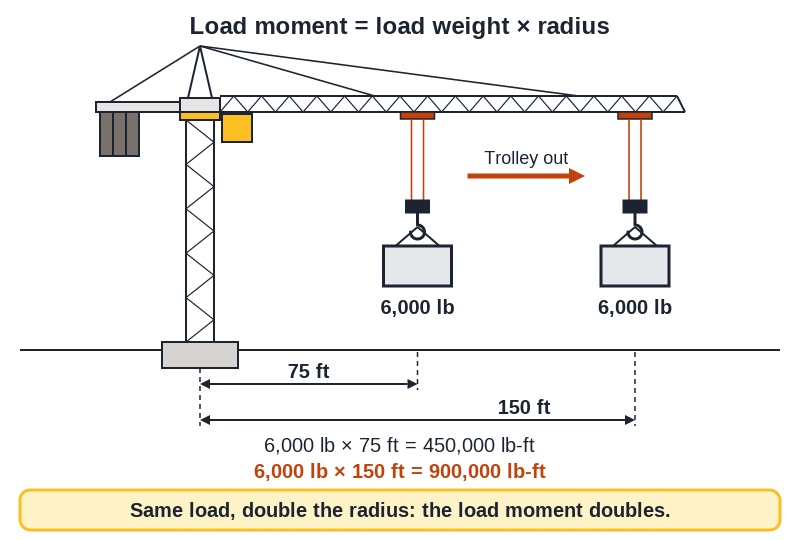
Load moment = load weight × radius
Moment is measured in pound-feet (lb-ft) in U.S. units.
Worked example. A 6,000 lb load hangs at a radius of 75 ft.
- Load moment = 6,000 lb × 75 ft = 450,000 lb-ft.
- The operator trolleys the same load out to 150 ft.
- Load moment = 6,000 lb × 150 ft = 900,000 lb-ft.
The load did not get heavier, but its effect on the crane doubled, because the radius doubled.
Watch the narrated video in the course portal.
That is why a tower crane's capacity falls as the radius grows. The tower, the slewing ring and the foundation can take only so much moment. Run the example backward: if 900,000 lb-ft were the limit, the crane could hold 6,000 lb at 150 ft but only 4,500 lb at 200 ft (900,000 ÷ 200).
Real load charts do not follow this simple sum exactly, because the weight of the trolley, hook block and rope also counts. Never work out a capacity from moment. Read it from the load chart.
Two limits: line pull and moment
Close to the tower the moment is small, so something else sets the limit: how hard the hoist can pull on the rope. That gives every tower crane chart the same shape.
| Zone | What limits the load | What the chart shows |
|---|---|---|
| From minimum radius out to a certain point | Hoist line pull | One maximum load, the same at every radius |
| From that point out to the jib tip | Load moment | Capacity falls steadily as radius grows |
Two devices guard these two limits: the hoist line pull limiter and the load moment limiter. You will meet both in Module 4.
What the counterweights do
The counterweights hang at the end of the counter-jib and push the opposite way to the load. They are sized to balance the weight of the jib plus part of the rated load. The result:
- With no load on the hook, the top of the crane is heavy toward the counter-jib. The tower leans back very slightly.
- With a full load on the hook, the top is heavy toward the jib. The tower leans forward very slightly.
The tower and foundation are designed for both cases. This is why the amount of counterweight is tied to the jib length. A shorter jib weighs less and needs less counterweight. Too much counterweight is as dangerous as too little: it overloads the crane backward when the hook is empty. OSHA 1926.1435(b)(8) puts it in two rules. The crane must not be erected, dismantled or operated without the amount and position of counterweight and ballast specified by the manufacturer or a registered professional engineer familiar with the equipment, and the specified maximum must not be exceeded.
Power systems
A tower crane uses three kinds of power. Most cranes combine them, for example an electric motor driving a hydraulic pump.
| System | Where it is used | Parts to know |
|---|---|---|
| Electrical | Hoist, trolley, slewing and travel drives; controls; limit switches; brakes | Supply cable, main disconnect, fuses or breakers, control cabinets, motors |
| Mechanical | Carries motor power to the rope or the ring gear | Gearboxes, drums, sheaves, wire rope, slewing pinion and ring gear |
| Hydraulic | Climbing cylinder; unfolding on self-erecting cranes; luffing on some cranes | Pump, valves, cylinder, hoses |
Power flow on a typical electric crane: site supply → main disconnect at the base → cable up the tower → collector (slip ring) at the slewing ring → control cabinets → motors → gearboxes → drums and slewing pinions → ropes and ring gear. A slip ring lets the upper crane turn without twisting the cable. A crane without one has a slewing limit that stops it after a set number of turns.
Brakes. OSHA 1926.1435(d) requires a hoist brake, swing brake, trolley brake and rail travel brake that set automatically if power or pressure is lost. In practice the brakes are spring-applied and power-released. No power means brakes on, so a power failure holds the load where it is.
Hydraulics. OSHA requires every load-supporting hydraulic cylinder to have a check valve mounted on the cylinder itself, and the system to have a pressure limiting device. If a hose bursts during climbing, the check valve keeps the cylinder from dropping the crane.
Power supply, disconnects, grounding and lightning
The exam's Site domain expects you to know the basics of the electrical supply. The details belong to a qualified electrician, the manual and the electrical code.
- Supply. The supply must match what the manufacturer specifies: voltage, phase, frequency and capacity. A weak supply or a long, undersized cable causes low voltage at the crane. Motors lose pulling power and run hot, and controls can drop out under load.
- Fuses and breakers. They protect the cable and the crane from overload and short circuits. They must be the size the manufacturer and the code call for. Never bypass one or fit a bigger one to stop it tripping.
- Disconnects. A main disconnect switch cuts all power to the crane. It must be reachable and lockable in the off position, so nobody can power up the crane while someone is working on it.
- Grounding. The crane structure, and the rails of a traveling crane, are connected to ground. Grounding gives fault current and lightning a path into the earth that does not pass through a person.
- Lightning. A tower crane is usually the tallest steel on the site, so it will be struck. Grounding protects the structure. It does not make the job safe to continue in a storm. Module 7 covers what to do.
Metric and U.S. customary units
Many tower cranes are built in Europe or Asia, and their manuals and displays are metric. You must be able to move between systems by hand.
| To change | Into | Multiply by |
|---|---|---|
| Meters (m) | Feet | 3.28 |
| Feet | Meters | 0.305 |
| Kilograms (kg) | Pounds | 2.2 |
| Metric tons (t) | Pounds | 2,205 |
| Kilometers per hour (km/h) | Miles per hour | 0.62 |
| Meters per second (m/s) | Miles per hour | 2.24 |
| Newton-meters (N·m) | Pound-feet of torque | 0.74 |
A metric ton (tonne) is 1,000 kg, or about 2,205 lb. A U.S. short ton is 2,000 lb. They are not the same.
Worked examples.
- A jib is 60 m long. In feet: 60 × 3.28 = 196.8, about 197 ft.
- A chart shows 2.5 t at the jib tip. In pounds: 2.5 × 2,205 = 5,512, about 5,500 lb.
- A precast panel is tagged 3,000 kg. In pounds: 3,000 × 2.2 = 6,600 lb. It is too heavy for that 5,500 lb tip capacity.
- A manual gives a wind limit of 72 km/h. In miles per hour: 72 × 0.62 = 44.6, about 45 mph. The same limit written as 20 m/s: 20 × 2.24 = 44.8, about 45 mph.
- A load is listed as 10 t. That is 10 × 2,205 = 22,050 lb. Treating it as 10 short tons (20,000 lb) would leave you 2,050 lb light, an error of about 10 percent.
On the exam: Expect a simple conversion or two and at least one question on load moment. Calculators are not allowed, so practice with round numbers. Classic mistakes: measuring radius from the tower face instead of the center of rotation, treating a metric ton as 2,000 lb, and believing that extra counterweight makes a crane safer.
Key points
- Load moment = load × radius. Double the radius and the moment doubles.
- Near the tower the hoist's line pull limits the load; farther out, load moment limits it.
- Counterweights balance the jib and part of the load. Use exactly the amount and position specified, never less and never more.
- Most cranes are electric, with hydraulics for climbing. Brakes must set automatically when power is lost.
- The crane needs the right supply, correct fuses, a lockable main disconnect and a sound ground.
- 1 m = 3.28 ft. 1 metric ton = 2,205 lb. 1 km/h = 0.62 mph.