
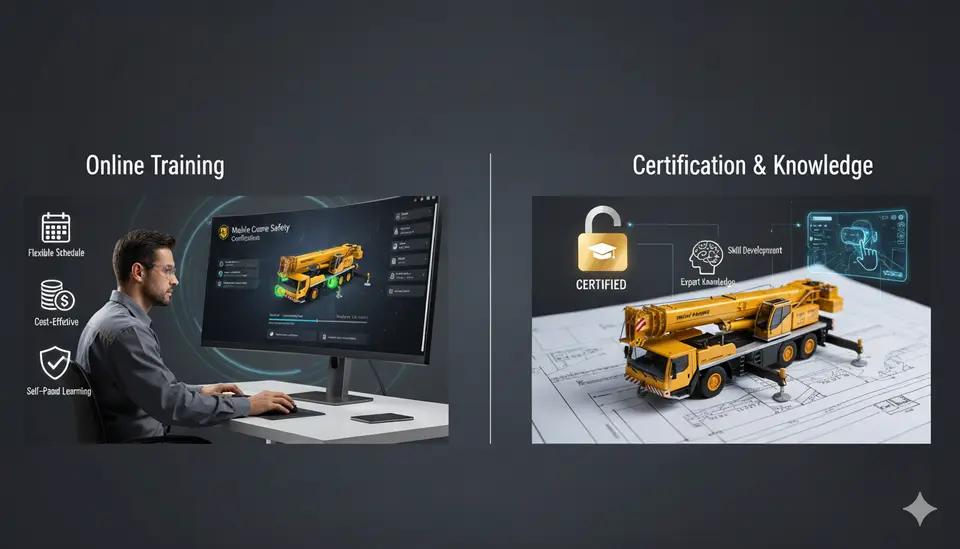
Four kinds of "online crane safety training"
The phrase covers very different products. Before comparing providers, figure out which category you are shopping in.
1. General construction safety awareness
Programs such as the OSHA 10-hour and 30-hour construction courses teach hazard recognition across a whole jobsite: falls, electrical, struck-by, caught-between and more. Cranes appear as one topic among many. These are excellent foundations for anyone on a crew, but they are not operator training and they do not lead to a crane credential.
2. Crane-specific awareness for ground personnel
Short courses aimed at laborers, foremen and anyone working near a lift. They explain swing radius hazards, why you never stand under a suspended load, and how signals and tag lines work. Useful for the people around the crane, too light for the person in the seat.
3. Certification exam preparation
Longer, structured courses built around the content outlines of an accredited certifying body such as NCCCO. They dig into load charts, setup, operations, technical knowledge and regulations at the depth the written exams demand. Our mobile crane certification prep falls in this category. These courses prepare you for the official tests; they do not issue the certification.
4. Refresher and recertification review
Aimed at experienced operators who need to update their knowledge or prepare for the NCCCO recertification written exam. Good refreshers focus on what operators forget or what has changed — chart footnotes, deductions, revised standards — rather than re-teaching basics. See the recertification prep course for an example.
What OSHA actually asks for
Federal crane rules for construction are in 29 CFR 1926 Subpart CC. Three requirements shape how employers think about training:
- Operator certification (1926.1427): operators must be certified by an accredited testing organization or qualified through an approved alternative, and employers must evaluate them on the equipment they will run.
- Training (1926.1430): employers must train operators and other workers on specific hazards, including power lines, two-blocking and the danger zones around the crane, and give operators-in-training supervised practice.
- Competent and qualified persons for inspections, assembly and rigging tasks.
Online learning can deliver much of the knowledge portion of those obligations. It cannot perform the employer's evaluation or replace supervised operation. Any provider claiming its online course makes you "OSHA certified to operate a crane" is overselling.
How to compare online options of the same type
Once you know which category you need, compare like with like. These are the questions that separate a solid course from a slideshow.
Is the content tied to a real standard? Prep courses should map to the current NCCCO candidate handbook. Awareness courses should reference Subpart CC and the relevant ASME B30 volumes (B30.5 for mobile cranes).
Does it teach load charts properly? Watching someone else read a chart is not enough. Look for worked problems where you calculate net capacity yourself, including deductions for block, hook and rigging.
Are there real assessments? Quizzes after each module and timed practice exams at the end. Instant feedback with explanations matters more than question count.
How current is it? Standards and exam outlines change. Ask when the material was last reviewed.
Can you reach a person? Phone or email support from someone who understands cranes is worth more than any animation.
How long does access last? If you need to pause for a busy season, expiring access becomes a hidden cost.
The limits of learning on a screen
Online mobile crane safety training is very good at concepts: why a crane tips, how radius changes capacity, what a minimum approach distance means near energized lines. It is poor at teaching feel — how the boom deflects, how a load swings when you stop a swing too abruptly, how soft ground behaves under an outrigger pad.
Treat online training as the classroom portion of your development. Pair it with:
- Supervised seat time on the class of crane you will run
- A site-specific orientation covering local hazards
- A practical exam if you are pursuing certification — the practical training guide explains how candidates arrange it
Red flags in course marketing
Some online crane courses are sold with promises the training cannot keep. Be cautious when you see:
- "Get your crane license online today." There is no national crane license, and no online course issues third-party operator certification.
- "No practical exam needed." Accredited operator certifications all include a hands-on test.
- "OSHA approved." OSHA does not approve or endorse individual training courses in this way; it sets requirements that training helps you meet.
- Wallet cards on completion. A completion certificate from a training provider is not the same as a certification card from NCCCO, CIC, NCCER or OECP.
- No mention of which standard or exam the course follows. Solid courses tell you exactly what they map to.
None of these red flags means online training is a bad idea. It means the honest providers describe what they do accurately. For more on how OSHA-related training fits an operator's development, see our guide to online OSHA training for crane operators.
A sensible path for most operators
- Take general construction safety awareness if you have not already; our OSHA course catalog lists options.
- Enroll in certification prep for the specific designation you need.
- Get supervised practice and book the practical through a CCO test site.
- After certification, use short refreshers between recertification cycles to stay sharp.
Choosing the right category first makes every other comparison easier. A cheap course that teaches the wrong thing costs more than a solid one that fits.