
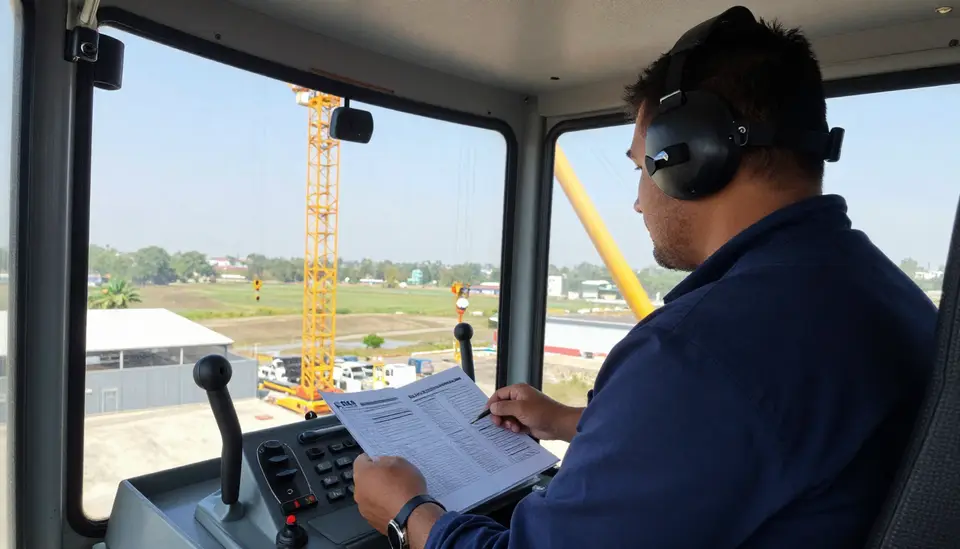
Ask ten operators what "OSHA training" means for crane work and you will get ten answers. Some mean the 10-hour card, some mean their certification, some mean the safety meeting every Monday. The confusion is understandable: OSHA's crane rules are spread across many sections, and only some of them describe training directly. The rest set duties that operators need to understand to do the job legally and safely.
Below is a practical tour of the federal construction standard, 29 CFR 1926 Subpart CC (Cranes and Derricks in Construction), written from the operator's seat. States that run their own OSHA-approved plans may add requirements, so check with your state program too.
The sections that shape an operator's day
Operator qualification and certification (1926.1427)
This is the big one. Operators of covered equipment must be certified by an accredited crane operator testing organization, or qualified through an audited employer program or a valid government license where one applies. Since the 2018 update, employers must also evaluate each operator's ability to run the specific equipment safely before letting them work unsupervised, and document that evaluation. Certification proves knowledge and general skill; the evaluation confirms you can handle this crane on this job.
Read the rule at osha.gov.
Inspections (1926.1412)
Operators are usually the competent person for the shift inspection, a visual check before and during each shift that covers control mechanisms, hydraulic systems, hooks and latches, wire rope, tires, ground conditions, level and safety devices. Monthly and annual inspections follow, with the annual done by a qualified person. Knowing what to look for, and when a deficiency takes the crane out of service, is examinable knowledge and daily practice.
Wire rope (1926.1413)
Wire rope inspection has its own section, with categories of deficiencies (broken wires, kinking, birdcaging, core protrusion, heat damage) and rules on what must happen when each is found.
Power lines (1926.1407–1411)
Electrocution from power line contact is one of the most serious hazards in crane work. The rules require the employer to identify the work zone, determine line voltage and keep the equipment beyond minimum clearance distances, or take specific protective measures such as a dedicated spotter, warning lines or de-energizing the line. Operators need to know these options and what to do if contact happens.
Ground conditions and setup (1926.1402)
Equipment may not be assembled or used unless ground conditions are firm, drained and graded enough, with supporting materials such as blocking or mats where needed, to meet the manufacturer's specifications. The controlling entity on site has responsibilities here too.
Signals (1926.1419–1422) and signal persons (1926.1428)
When the operator cannot see the load or the landing area, or the operator or a person handling the load decides it is needed, a signal person is required. That signal person must be qualified, either through a third-party qualified evaluator or the employer's own qualified evaluator. Operators must know the standard hand signals and follow radio protocols.
Assembly, disassembly and riggers (1926.1403–1404, 1425)
Assembly and disassembly must be directed by a competent and qualified person, and some rigging tasks require a qualified rigger. Fall-zone rules govern who may be near a suspended load.
Where online training fits
None of these sections can be satisfied by a single course, but several kinds of online training map neatly onto them:
| OSHA area | Online training that supports it |
|---|---|
| Operator certification (1926.1427) | Written-exam prep for NCCCO, CIC, NCCER or OECP, such as our online mobile crane prep |
| Signal person qualification (1926.1428) | Signal person training ahead of evaluation |
| Qualified rigger tasks (1926.1404, 1425) | Rigger Level I preparation |
| Inspections (1926.1412) | Crane inspector training for those who perform periodic inspections |
| General hazard awareness | OSHA Outreach 10-hour or 30-hour construction courses |
Two caveats apply. First, online prep is preparation: the operator certification itself still requires official written and practical exams. Second, employer evaluation is always an on-site, hands-on process.
Is an OSHA 10 or 30 card required?
Federal OSHA does not require the 10- or 30-hour card for crane operators as a general rule. Some states, cities, unions and project owners do. Even where it is not required, the 30-hour construction course is a sensible step for operators heading toward lead or supervisory roles because it broadens hazard knowledge beyond the crane. You can take OSHA 10-Hour Construction online through our store.
Building a training plan
- List the equipment you run and confirm which certification designations you need.
- Prepare for and pass the certification exams, written and practical.
- Complete your employer's evaluation for each machine type.
- Add supporting qualifications (signals, rigging) that match the tasks you perform.
- Track renewal dates. NCCCO certifications run five years; mark them early.
Common gaps auditors notice
- Shift inspections done but not documented where the employer requires it.
- Signal persons directing lifts without documented qualification.
- No written evaluation for an operator who moved to a new crane type.
- Power line work zones not identified before setup.
Each of these is a training and habit issue more than an equipment issue, which is why knowledge matters as much as seat time.
Learn more
For the broader regulatory picture, see our post on understanding OSHA crane certification requirements, or browse the full list of online OSHA safety courses.