
OSHA writes the rule; others run the tests
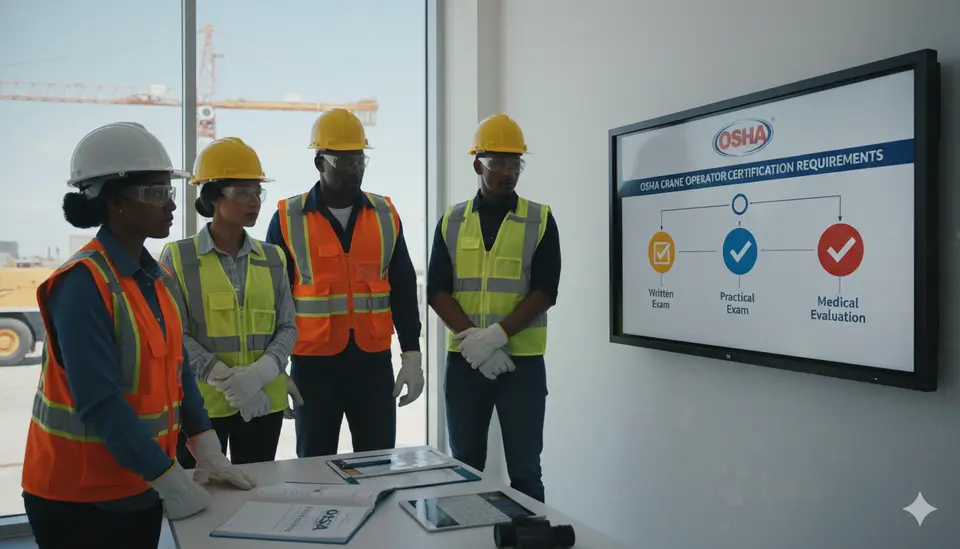
The Occupational Safety and Health Administration regulates crane work in construction under 29 CFR 1926 Subpart CC, "Cranes and Derricks in Construction." Within it, section 1926.1427 covers operator qualification and certification. OSHA does not run crane exams. It tells employers that their operators must be certified through an acceptable route and then evaluated on the job.
That split confuses people. You will hear "OSHA certified crane operator," but the card in your wallet comes from an organization such as NCCCO, NCCER, CIC or OECP that meets OSHA's criteria. Our page comparing CIC, NCCCO, NCCER and OECP explains how those bodies differ.
This article summarizes the rules for general understanding. For compliance decisions, read the current text at osha.gov and consult a qualified safety professional.
Who the requirement covers
Section 1926.1427 applies to operators of most power-operated cranes and derricks used in construction, such as mobile cranes (truck-mounted, rough-terrain, all-terrain and crawler), tower cranes, boom trucks, and articulating cranes when used to hoist loads in construction.
There are notable carve-outs. Operator certification under 1926.1427 does not apply to operators of:
- Derricks, which are addressed in 1926.1436
- Sideboom cranes, addressed in 1926.1440
- Equipment with a maximum manufacturer-rated capacity of 2,000 pounds or less, addressed in 1926.1441
Those sections still require operators to be trained and competent; they simply do not demand third-party certification. Subpart CC also excludes some equipment entirely, so check 1926.1400 for the scope list if your machine is unusual.
The accepted certification routes
OSHA recognizes several ways to meet the certification requirement:
- An accredited crane operator testing organization. The testing organization must be accredited by a nationally recognized accrediting agency, and its exams must include both a written and a practical test. This is the route most operators take.
- An audited employer program. An employer may qualify its own operators if the program meets OSHA's criteria and is audited. It is not portable to other employers.
- U.S. military qualification for operators employed by the military on military equipment.
- State or local licensing, where a jurisdiction requires a license that meets OSHA's minimum criteria. Operators working there must hold that license.
Certification is by crane type. Following OSHA's 2018 update, certifying by capacity is permitted but not required.
The employer's job does not end with the card
The same 2018 update made something explicit: a certification is not enough on its own. Employers must evaluate each operator to confirm they can safely run the specific equipment for the work assigned, and they must document that evaluation. The evaluator must be qualified to judge the operator's skill.
Employers also have to provide training when an operator needs it, for example on a new model, a different configuration or new attachments. In short, the certification proves baseline knowledge and skill; the evaluation proves fitness for this crane, this job.
Operators in training
OSHA allows an operator who is not yet certified to run equipment as an operator-in-training, provided strict conditions are met, including supervision by a qualified trainer who is in immediate contact and restrictions on certain hazardous tasks. This is how many new operators gain the seat time they need before their practical exam. Our practical training guide explains how candidates use this period.
Related people on the crane crew
Subpart CC also sets qualification rules for other roles:
- Signal persons must be qualified under 1926.1428, either through a third-party qualified evaluator or an employer's qualified evaluator. Our signal person training covers the knowledge side.
- Riggers must be qualified for assembly and disassembly work (1926.1404) and when workers are in the fall zone while hooking or unhooking loads (1926.1425).
- Inspections under 1926.1412 must be performed by competent or qualified persons, depending on the inspection type.
What about general industry?
Outside construction, overhead and gantry cranes fall under 29 CFR 1910.179 and crawler, locomotive and truck cranes under 1910.180. Those standards require operators to be trained and designated, but they do not impose third-party certification the way 1926.1427 does. Many manufacturers and plants still choose certification for the assurance it provides; our overhead crane operator overview covers one such credential.
State and city licensing
Some states and cities run their own crane operator licensing on top of OSHA. Requirements, recognized certifications and renewal rules vary. If you work in a licensing jurisdiction, check with the state or city agency directly before you assume a national card is enough. Our location pages summarize the situation state by state, with the reminder to verify locally.
How certification renews
OSHA requires that certifications from accredited testing organizations be valid for no more than five years. NCCCO cards follow that five-year cycle. Our article on NCCCO recertification requirements walks through the renewal process.
Putting it together
| Requirement | Who is responsible | Source |
|---|---|---|
| Operator certification by crane type | Operator earns; employer verifies | 1926.1427 |
| Operator evaluation and documentation | Employer | 1926.1427 |
| Additional training on new equipment | Employer | 1926.1427 |
| Signal person qualification | Employer ensures | 1926.1428 |
| Qualified rigger for specified tasks | Employer ensures | 1926.1404, 1926.1425 |
| Power line safety | Employer and crew | 1926.1407–1411 |
For operators, the practical takeaway is simple: earn a recognized certification for the type of crane you run, expect your employer to evaluate you on their equipment, and keep the card current. Self-paced prep such as our mobile crane online training helps with the written exams; the practical is taken in person with an accredited examiner.