
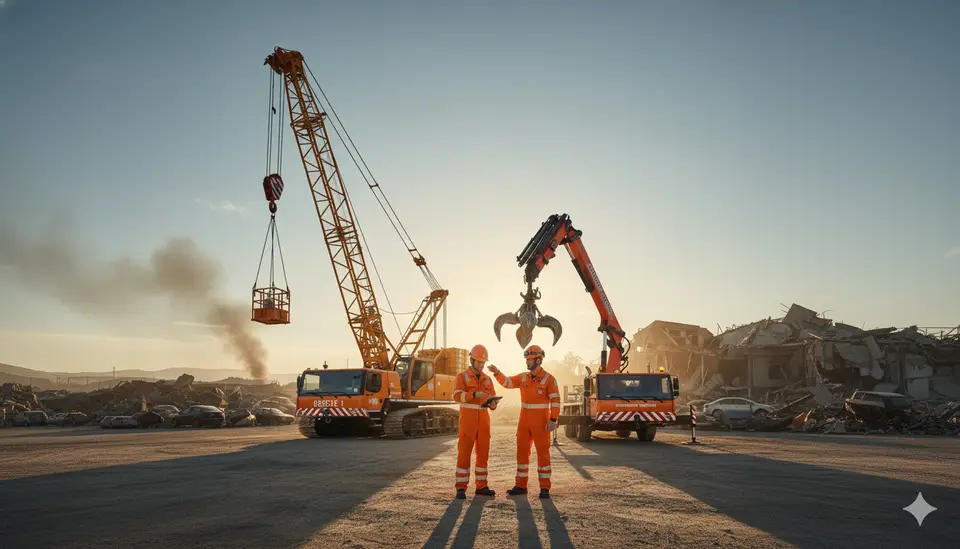
Why emergency lifts are different
A planned construction lift starts with a survey, an engineered setup and known load weights. An emergency lift often starts with none of those. Ground may be saturated or undermined. Loads are irregular — collapsed structural members, vehicles, uprooted trees, damaged utility poles — and their weights are estimates at best. Power lines may be down or, worse, still energized. People are working close by under stress, and the pressure to move fast is enormous.
Those conditions do not call for a different certification. They call for people who have mastered the fundamentals so thoroughly that they can apply them without shortcuts. NCCCO does not offer an "emergency" credential; responders earn the same certifications as construction crews. The real decision is which credentials, held by which people.
The four roles on a response lift
Crane operator
The operator is responsible for the machine: setup, capacity, controlled movement and stopping when something is wrong. In storm and disaster recovery the most common machines are hydraulic truck and rough-terrain cranes, which fall under the NCCCO TLL (telescopic boom, swing cab) specialty, and boom trucks under TSS (telescopic boom, fixed cab). Contractors handling very heavy debris may bring crawlers covered by the LBC designation, and utility crews often run articulating (knuckle-boom) cranes or digger derricks with their own certifications.
Preparation starts with the mobile crane exam prep course for the Core and specialty written exams. For articulating units, see the articulating crane prep.
Rigger
Unknown loads make rigging the most dangerous variable on a recovery site. A Rigger Level I knows how to inspect slings and hardware, identify a load's center of gravity and use basic hitches. Rigger Level II adds weight estimation, sling angle and tension calculations and more complex rigging decisions — skills that matter when the load is a twisted piece of a building. The Rigger Level II overview explains what that exam covers.
Signalperson
When the operator cannot see the load or the landing area, everything depends on signals. OSHA requires a qualified signal person whenever the operator's view is obstructed or the operator or the person handling the load decides one is needed. Rescue scenes almost always meet that test. NCCCO's Signalperson certification documents that qualification through a written and practical exam.
Lift director
On complex recoveries, someone has to own the plan: picking the crane location, verifying capacities, coordinating multiple crews and calling a stop. NCCCO's Lift Director credential is designed for that person. It suits incident commanders' technical specialists, contractor superintendents and senior operators.
Comparing the options for different teams
| Team type | Most valuable first credential | Next step |
|---|---|---|
| Fire or rescue team that calls in contract cranes | Signalperson | Rigger Level I |
| Public works or DOT crew with its own crane | Operator (TLL or TSS) | Rigger Level I for the ground crew |
| Utility storm-response crew | Digger derrick or articulating operator | Signalperson for line workers |
| Heavy recovery contractor | Operator (TLL, LBC) | Rigger Level II and Lift Director |
The pattern is worth noticing: teams that do not own cranes still need certified people on the ground, because they control the hook from below.
Online or in-person preparation for responders?
Shift work defines most emergency services. Twenty-four-hour shifts, mandatory overtime during disasters and unpredictable call volumes make it hard to commit to a fixed week of classroom training. Self-paced online prep handles that well: study during quiet periods at the station, stop when the tones drop, and pick up where you left off.
In-person training has real advantages for responders too, especially joint drills where firefighters, riggers and operators practice together. A sensible approach for many agencies is to handle the knowledge work online — load charts, sling angles, OSHA signal requirements — and spend precious hands-on time on scenario drills and practical exams.
When comparing options, ask about cost factors beyond tuition: travel and backfill coverage for classroom days, how long online access lasts, whether practice tests are included and what exam fees the certifying body charges separately.
Building an agency-wide plan
Response organizations tend to train in bursts after a major event, then let skills fade. A steadier plan works better:
- Map your lifting scenarios. List the lifts your team realistically performs or supports: vehicle extrication assists, structural collapse shoring, trench rescue, storm debris, utility restoration.
- Assign roles to each scenario. Who directs the lift, who rigs, who signals and who operates, if anyone on your team operates at all?
- Close the biggest gap first. For most fire and rescue teams that is signaling and rigging; for public works crews it is often operator certification.
- Train with your mutual-aid partners. Contract crane companies and neighboring agencies should know your signal conventions before the day you need them.
- Document everything. Keep copies of every certification and qualification so the incident commander knows who is authorized to do what.
Rigging deserves particular emphasis because it is the skill most often improvised in emergencies. Our article on the benefits of rigging certification for operators and employers explains why it pays off.
Keeping credentials current
All NCCCO certifications expire after five years. Emergency teams can lose several certified members to retirement and transfers in that span, so track expiry dates centrally and stagger recertification so the team is never short. The recertification prep course helps experienced holders review efficiently.
The takeaway
There is no shortcut certification for disaster work. Build depth in the standard NCCCO credentials across the whole team — operators, riggers, signal persons and someone qualified to direct the lift — so that when conditions are at their worst, the fundamentals are second nature. Our page on crane and rigging training for fire and rescue goes further into program options for responders.