
Why we compare formats, not brands
Lists that rank "the top five crane schools" are rarely useful. Course content changes, prices move and what suits a union apprentice in Chicago is wrong for a ranch hand in Wyoming who needs to run a boom truck. What stays stable is the format of a program and what that format can and cannot deliver. Pick the right format first, then compare providers inside it.
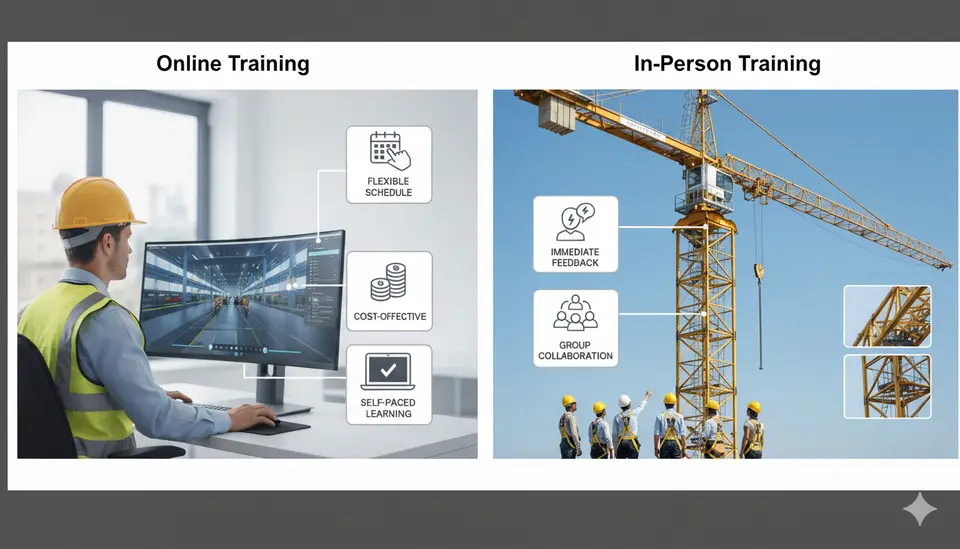
Format 1: Self-paced online exam prep
How it works: You enroll, get access to modules covering the written exam content, and work through them on your own schedule from a phone, tablet or computer. Practice tests round out the course.
Strengths: Total schedule flexibility, no travel, the ability to re-watch hard topics and skip what you know. Cost is usually lower than classroom formats once travel and lost wages are counted.
Limitations: No hands-on time. Requires self-discipline. You must arrange the practical exam separately.
Best for: Working operators who need certification or recertification, people adding a specialty, and anyone who already has access to a crane through an employer. This is the format The Online Crane School offers; our course catalog lists the designations covered.
Format 2: Live virtual classroom
How it works: An instructor teaches on video at set times. Students ask questions in real time, and sessions are sometimes recorded.
Strengths: Structure and accountability, live answers to questions, some interaction with other students.
Limitations: Fixed schedules are hard for shift workers and anyone in a different time zone. Still no hands-on component.
Best for: Learners who procrastinate without deadlines or who want to ask questions as they go.
Format 3: Hybrid (online theory plus in-person practice)
How it works: You complete the knowledge portion online, then attend scheduled sessions at a training yard for supervised operation, often ending with a practical exam.
Strengths: Covers both halves of certification. Travel is limited to the hands-on days.
Limitations: Yard days are fixed and may be far away. Total cost includes crane time, which is expensive to provide.
Best for: Newcomers without employer access to equipment who want a complete path. Our practical training explainer describes what to look for in the hands-on portion.
Format 4: Apprenticeship
How it works: A multi-year, earn-while-you-learn program, typically through an operating engineers' union or an employer-sponsored registered apprenticeship, combining classroom hours with paid on-the-job training.
Strengths: Deep, supervised experience across many machines, wages from the start and a clear career ladder.
Limitations: Competitive entry, long commitment and limited control over location and timing.
Best for: People at the very start of a career who want to make heavy equipment their trade. The IUOE's training arm (iuoeiettc.org) is one place to learn how union programs work.
Format 5: Employer in-house training
How it works: Your company trains you on its equipment, evaluates you and often pays for certification exams.
Strengths: Training on the exact cranes you will run, with no cost to you in many cases.
Limitations: Quality varies. Internal training alone does not produce third-party certification, which OSHA requires for most construction crane operators under 29 CFR 1926.1427.
Best for: Current employees. Many employers pair in-house seat time with an online written-exam course — a very efficient combination.
Side-by-side summary
| Format | Hands-on time | Schedule control | Travel | Typical learner |
|---|---|---|---|---|
| Self-paced online | None | High | None | Working operator |
| Live virtual | None | Low | None | Needs structure |
| Hybrid | Yes | Medium | Some | Newcomer, no crane access |
| Apprenticeship | Extensive | Low | Varies | Career starter |
| Employer in-house | Yes | Low | None | Current employee |
Questions to ask inside any format
- Which certifying body and which designations does the program prepare you for? The comparison of NCCCO, CIC, NCCER and OECP helps you decide which one to target.
- Is the content current with the certifying body's published outlines?
- Are practice exams included, timed and explained?
- What exactly is included in the price, and what is charged separately (exam fees, crane rental, extended access)?
- Can you reach someone knowledgeable when you are stuck?
Warning signs in any program
Whatever format you pick, walk away from programs that:
- Claim their course is NCCCO, CIC, NCCER or OECP certification, or that you will leave "licensed"
- Promise you can skip the practical exam
- Cannot tell you which exam outline their material follows
- Bundle exam fees vaguely so you cannot tell what you are paying the certifying body versus the trainer
- Pressure you to enroll immediately without answering questions
Legitimate programs, online or in person, are happy to explain where their role ends and the certifying body's begins. That clarity is one of the best indicators of quality you will find.
Combining formats
You are not limited to one format. A common and effective pattern is to do the theory online, gain seat time through an employer or apprenticeship, and use a short in-person session to polish practical skills right before the exam. Our article on the steps to becoming a certified crane operator shows how those pieces fit over a career's first few years.
Matching format to career stage
Just starting out: apprenticeship or hybrid, supported by self-paced online study for the written exam. Working operator, no card yet: employer seat time plus self-paced prep and practice tests. Certified, adding a crane type: self-paced specialty prep. Renewing: a focused online refresher such as our recertification course.
The right program is the one that closes your particular gap — knowledge, seat time or both — at a cost and pace you can sustain.