
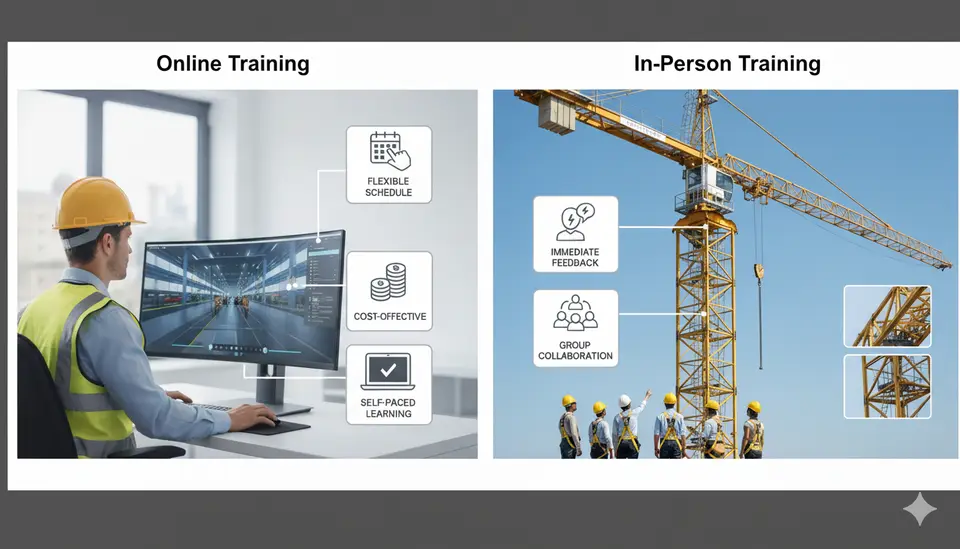
What makes tower crane certification different
Tower cranes are the tall, fixed cranes you see on high-rise and large commercial jobs. The common types are hammerhead (also called saddle-jib or flat-top), where the trolley runs along a horizontal jib, and luffing jib cranes, which raise and lower the jib to change radius and are favored on tight urban sites. Self-erecting tower cranes are smaller units that unfold on site.
Several features change how tower operators are trained and tested:
- The operator often cannot see the load. Many lifts are blind, so radio communication with a signal person is constant.
- Wind matters enormously. A tall crane with a long jib catches wind, and operators must know the manufacturer's limits and the weathervaning (free-slew) procedures for out-of-service conditions.
- Load charts look different. Capacity is tied to trolley position or luffing angle and jib configuration rather than boom length and outrigger setup.
- Assembly and climbing are specialized tasks done by erection crews under the manufacturer's procedures, but operators need to understand them.
The consensus standard is ASME B30.3, and construction use falls under OSHA 29 CFR 1926 Subpart CC, which includes tower-specific provisions.
The NCCCO tower crane exams
NCCCO's Tower Crane Operator certification has its own written exam and practical exam. It does not use the mobile crane Core-plus-specialty structure. The written exam covers site knowledge, operations, technical knowledge, load charts and regulations as they apply to tower cranes. The practical requires you to demonstrate controlled operation on an actual tower crane under an accredited examiner.
As with all NCCCO credentials, certification lasts five years. The NCCCO tower crane overview summarizes eligibility and recertification.
Online tower crane courses
What they do well: Online courses are an efficient way to master the written exam material. You can work through tower-specific load charts repeatedly, study wind and out-of-service procedures until they stick, and drill regulation questions. Because tower crane jobs are often in big cities with long commutes, studying at home in the evening is a real advantage. Our tower crane training course is built around the written exam content.
What they cannot do: Teach you to feel the slewing inertia of a long jib, judge trolley speed with a load on, or settle into a cab high above the street. They also cannot give you the practical exam.
In-person tower crane courses
What they do well: A program with a tower crane on site gives supervised seat time and, often, a practical exam at the end. Live instruction makes it easy to ask about the specific crane model you will run.
What to watch for: Tower cranes are expensive to erect for training, so these programs are relatively few and often require travel. Class dates are fixed. Ask exactly how much individual seat time each student gets rather than how long the course runs.
Side-by-side comparison
| Factor | Online course | In-person course |
|---|---|---|
| Written exam preparation | Thorough, self-paced | Thorough, scheduled |
| Seat time on a tower crane | None | Varies — ask for hours per student |
| Practical exam | Arranged separately | Sometimes included |
| Travel | None for study | Usually required |
| Schedule | Fully flexible | Fixed dates |
| Cost factors to ask about | Course fee, access length, practice tests | Tuition, travel, lodging, lost wages, exam fees |
A blended path that works for most candidates
Because practical tower crane time is scarce, it makes sense to arrive fully prepared for the written exam so that your hands-on hours are spent on operating skill rather than catching up on theory.
- Study the written material online and pass practice tests consistently. Our CCO practice tests help you gauge readiness.
- Take the written exam at an approved testing location.
- Get seat time. Most tower operators build hours through an employer, often starting by working alongside an experienced operator, or through an apprenticeship.
- Book the practical early. Use the test site finder and keep the NCCCO window between written and practical in mind.
- Review the practical exam checklist the week before.
Topics to master before the tower written exam
Whichever format you choose, the written exam expects you to be comfortable with:
- Tower load charts — capacity by trolley radius or luffing angle, the effect of jib length and the difference between maximum capacity near the mast and tip capacity at full radius.
- Wind and weather — in-service wind limits, out-of-service procedures and why the slewing brake must be released so the jib can weathervane.
- Limit and safety devices — hoist, trolley and slewing limits and the load moment and maximum load limiters that protect the structure.
- Site hazards — overlapping cranes on the same site, obstructions near the jib path and working near power lines.
- Communication — radio protocol, dedicated channels and the rules for voice signals during blind lifts.
- Regulations — the tower-specific provisions in Subpart CC alongside the general crane rules.
Treat each item as a checklist line and do not book the exam until you can explain all of them. Our article on preparing for NCCCO exams has broader study advice that applies to tower candidates too.
Who should choose which
Choose online-first if you already have employer access to a tower crane, you are a mobile crane operator moving into tower work with a company that will give you seat time, or you are renewing.
Choose an in-person program if you have no realistic access to a tower crane and need a complete package including the practical.
Either way, the written exam is the part you control most directly. Get it done well, and the scarce practical hours go much further.