
Crane incidents tend to trace back to a short list of causes: overloading, poor ground support, power line contact, rigging failures and miscommunication between the operator and the crew. Every one of those is a knowledge problem before it becomes a mechanical one. That is why safety training matters, and why the question of how to deliver it deserves a straight answer.
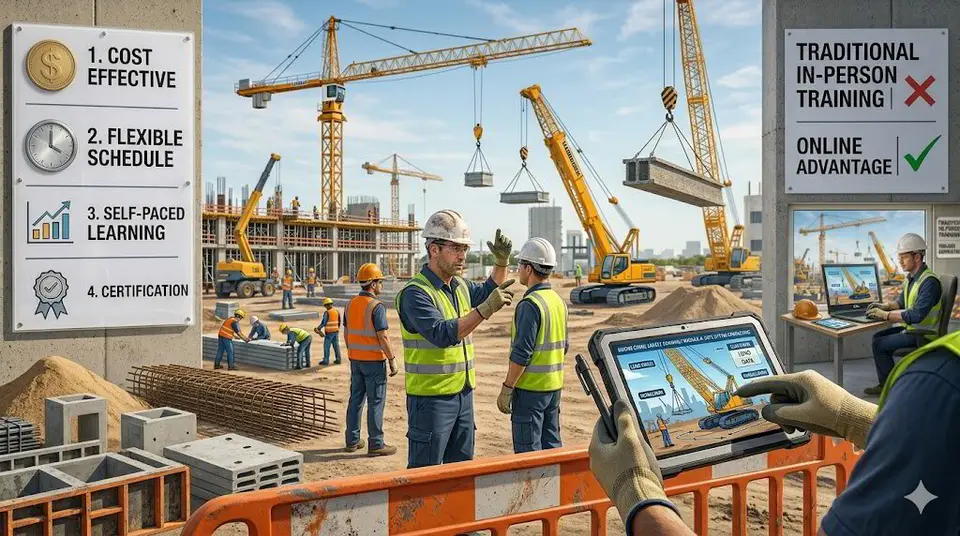
This comparison looks at online crane safety training next to traditional classroom instruction, from the point of view of both the individual operator and the person responsible for a crew.
The short version
| Factor | Online, self-paced | Classroom, instructor-led |
|---|---|---|
| Scheduling | Study any time, in short sessions | Fixed dates and hours |
| Travel | None | Often travel and time off work |
| Pace | Repeat hard topics as often as needed | Group moves at one speed |
| Questions answered | Through support channels, not instantly | On the spot |
| Hands-on equipment time | None | Sometimes included, often limited |
| Consistency across a crew | Everyone gets identical content | Depends on instructor and session |
| Self-discipline needed | High | Lower |
Neither column wins outright. What matters is which trade-offs fit your situation.
Where online crane safety training pulls ahead
It fits around the job
Construction schedules do not leave many free weekdays. Online study lets an operator work through a module after a shift, during a weather delay, or on a Sunday morning. Nobody has to lose a week of wages to sit in a hotel conference room.
You control the pace
In a classroom, the instructor moves on when most of the room is ready. Online, you can replay the section on power line encroachment zones three times if that is what it takes, then skip quickly through material you already know from years in the seat.
Repetition is built in
Safety knowledge fades. Online formats make it easy to revisit a topic before a difficult lift or ahead of a renewal exam. Short quizzes after each lesson also show you, and your supervisor, where the soft spots are.
Crews get the same message
For a safety manager with operators spread across several sites, online delivery means every person receives the same content in the same order. That makes it simpler to document who has completed what — a real benefit when you need to show that training happened.
Where online training falls short
No machine under you
The biggest limitation is obvious: you cannot feel a load swing or set outriggers through a screen. Video and diagrams help, but competence on equipment comes from supervised practice. Our explainer on crane practical training and seat time covers how candidates usually arrange it.
Questions wait
When something does not make sense in a classroom, you raise your hand. Online, you send a message or call. Good providers answer quickly, but it is still a delay, and some learners find that frustrating.
It takes self-discipline
Self-paced courses only work if you actually sit down and do them. People who struggle to study without a fixed time slot should build one into their week, or pair up with a coworker taking the same course.
Technology can get in the way
A slow connection on a remote site or an unfamiliar platform can turn a 30-minute session into an hour. Check that a course works on the device you will actually use before you commit.
Blending the two: what works in practice
Most effective programs do not choose one format. They use each for what it does best:
- Online for knowledge. Regulations, load chart reading, rigging principles, signals and inspection checklists.
- On the job for skill. Supervised operation, pre-use inspections on real machines, and practice lifts with a qualified mentor.
- Short toolbox talks to reinforce. Five-minute crew discussions that tie the online lessons to the lift happening that day.
For safety managers, this also splits the documentation neatly: online records show the knowledge component, and jobsite evaluations show practical ability. OSHA requires employers to evaluate operators on the equipment they will use, separate from certification — see 29 CFR 1926.1427 for the details.
Choosing courses for a crew
Start with the equipment and the hazards your crews actually face. Operators preparing for certification need equipment-specific exam prep from our crane course catalog. For the broader site hazards that surround crane work, general safety courses help too: our OSHA 10-Hour Construction Safety course suits front-line workers, while OSHA 30-Hour Construction Safety is aimed at supervisors and leads. The full list of topic courses is on our OSHA safety training page.
If you run a general contracting crew, our page on crane and rigging certification for construction workers explains which credentials usually matter on building sites. And for a closer look at how OSHA topics map to crane work, read online OSHA training for crane operators.
A note for individual operators
If nobody is paying for your training, the decision is simpler but still worth thinking through. Count the true cost of each option: tuition, plus travel, plus any unpaid days off. Then think honestly about how you study best. If you will actually sit down three or four evenings a week, online study is hard to beat. If you know you need someone holding you to a schedule, a classroom or a study partner may be worth the extra cost.
The bottom line
Online crane safety training is flexible, consistent and easy to repeat, which makes it an excellent way to build and refresh knowledge. It does not replace hands-on evaluation, and it asks more discipline of the learner. Pair it with supervised seat time and you get the strengths of both formats without their weak points.