
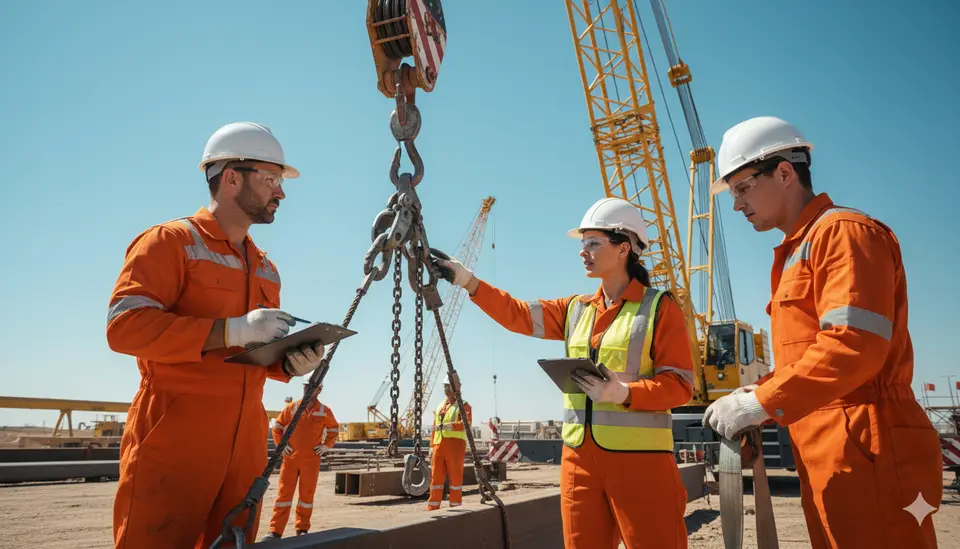
On most jobsites, the people who attach loads to cranes fall into two broad groups. Some can rig a routine lift safely once someone else has worked out the plan. Others can look at an awkward, off-center or heavy load and figure out how to rig it from scratch. Rigger Level II exists to recognize that second group.
This guide breaks down Rigger Level II training requirements, using NCCCO's program as the main reference point. Certifying bodies update their rules, so confirm eligibility and exam details in the current candidate handbook at nccco.org before you register.
Where rigging qualification comes from
OSHA's crane standard requires that rigging work during assembly and disassembly, and when workers are within the fall zone during hooking and unhooking, be done by a qualified rigger (see 29 CFR 1926.1404 and 1926.1425). OSHA does not itself require a specific certificate to show that someone is qualified; employers can determine it. In practice, many contractors and owners use an accredited certification such as NCCCO's Rigger Level I or Level II as clear, portable evidence.
Level I versus Level II
| Rigger Level I | Rigger Level II | |
|---|---|---|
| Typical role | Rigs routine lifts following a plan | Plans rigging and directs others on complex lifts |
| Load weight | Uses provided weights | Estimates weight from dimensions and materials |
| Center of gravity | Recognizes basic CoG issues | Calculates CoG and load share on rigging legs |
| Hardware | Inspects and uses common slings and hardware | Selects spreader and lifting beams, equalizers and specialty devices |
| Load handling | Standard hitches and basic lifts | Turning, upending, drifting and multi-point lifts |
| Planning | Follows the plan | Builds and documents the rigging plan |
The step from Level I to Level II is less about new hardware and more about judgment. A Level II rigger is expected to look at an unfamiliar load and make the right decisions without someone else doing the math.
Do you need Level I first?
Most people do earn Rigger Level I before Level II, and the Level I material is the foundation the higher level builds on. Whether Level I is a formal prerequisite depends on the certifying body and its current rules, so check the handbook. If your fundamentals are rusty, our Rigger Level I prep is the place to start.
What the Level II exams cover
NCCCO Rigger Level II certification requires passing both a written exam and a practical exam. While the published outline is the final word, the knowledge areas generally fall into these groups.
Load calculations
- estimating load weight from volume and material density
- finding the center of gravity of irregular or composite loads
- calculating the share of load on each rigging leg when the hook is not centered
- sling tension at different angles, and why low angles multiply force
Rigging equipment
- slings of every common type, with ASME B30.9 inspection and removal criteria
- hardware such as shackles, eyebolts, hoist rings and turnbuckles under ASME B30.26
- below-the-hook lifting devices, including spreader and lifting beams
- rated capacities, reduction factors for hitches and D/d ratios
Rigging practices and planning
- choosing hitches and configurations for the load and the lift
- tagline use, load control and turning or upending techniques
- multi-crane and multi-point lifts at a conceptual level
- documenting a rigging plan with gear, angles, capacities and contingencies
Communication and crane awareness
- standard hand signals and voice communication
- enough crane knowledge to understand how rigging weight and radius affect the operator's capacity
The practical exam
The practical exam puts you in front of an examiner with real gear. Expect tasks such as identifying and inspecting rigging, choosing the right components for a described load, and demonstrating correct hitches and procedures. The exact tasks are set by the certifying body, so review its practical exam information ahead of time. Our practical test checklist can help you organize that review.
Certification prep or qualification course?
We offer two kinds of Level II training, and they serve different needs:
- Rigger Level II Certification — exam-focused prep for people heading to an accredited written and practical exam.
- Rigger Level II Qualification — a structured course with a certificate of completion for employers who document qualification internally.
If you are unsure which your employer or project requires, ask before you enroll. Our comparison of certifying bodies also helps if a specific certifier is named in your contract.
How to prepare
- Confirm your target. NCCCO and NCCER both offer Level II rigging credentials. Read the overview for NCCCO Rigger Level II or NCCER Rigger Level II to see which applies.
- Rebuild the math. Work CoG and sling tension problems until they are routine. These calculations underpin most of the exam.
- Handle real gear. Practice inspecting slings and hardware against removal criteria. Reading about a damaged sling is not the same as finding one.
- Write a rigging plan. Take a real or imagined awkward load and plan it fully. Then have an experienced rigger critique it.
- Study the standards. Skim ASME B30.9 and B30.26 for the topics most likely to be tested.
Our online Rigger Level II training walks through these areas in order, so you can study between shifts.
Keeping the credential
NCCCO rigging certifications are valid for five years. Plan recertification well before your card expires and keep notes on the rigging work you do in the meantime.
For crews who need both levels across a workforce, see our page on rigging certification for industrial crews. And if you want a refresher on the foundation first, read understanding Rigger Level 1 certification.