
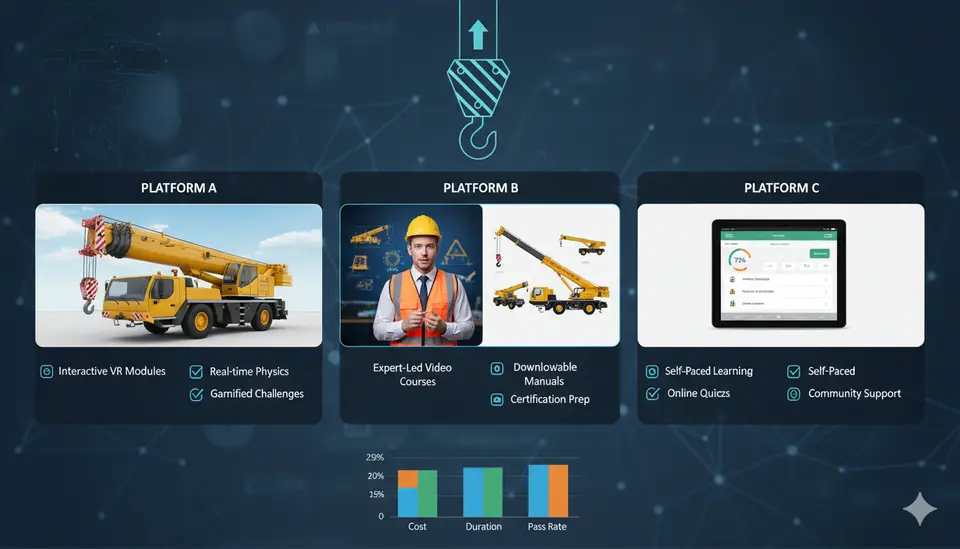
Search for crane operator training and you will find dozens of options, each claiming to be the best. The truth is less exciting: different programs are built for different people. A union apprentice with no crane experience, a twenty-year operator facing recertification and a safety manager training a whole crew all need something different.
This guide skips the brand rankings and instead compares the types of programs available, then gives you a scorecard to judge any provider on your own.
Why Training Matters Beyond the Card
OSHA's crane standard (29 CFR 1926 Subpart CC) requires operators of most construction cranes to be certified by an accredited testing organization and evaluated by their employer. Certification proves you met a recognized standard on test day. Training is what gets you there, and good training also makes you safer and more confident on the job long after the exam.
The Main Types of Crane Training Programs
Dedicated online crane exam-prep schools
These focus specifically on crane, rigging and signaling exams. Courses are organized by certification and designation, with load chart instruction and practice tests aligned to a certifying body's outline. The Online Crane School falls into this category; see our catalog of crane courses.
Strengths: depth on crane-specific topics; designation-level detail; flexible schedules. Watch for: no seat time; you arrange the practical exam separately.
General safety-training catalogs
Large online providers that sell hundreds of safety topics, with crane courses as one item among many.
Strengths: convenient if your company already buys other training from them; good for general awareness. Watch for: crane content may be awareness-level rather than exam-level; check whether it actually maps to a certification exam outline.
Union apprenticeship programs
Operating engineers' unions run multi-year apprenticeships that combine classroom training, extensive seat time and paid on-the-job work. The International Union of Operating Engineers' training trust (iuoeiettc.org) is a starting point for learning about local programs.
Strengths: thorough, hands-on, career-oriented, often paid. Watch for: competitive entry, set schedules, and a long-term commitment.
Technical colleges and private operator schools
Programs with their own training yards and cranes, typically lasting days to weeks.
Strengths: real seat time; written and practical exams can often be scheduled together. Watch for: travel and time away from work; group pacing.
Employer and dealer training
Large contractors, rental companies and equipment dealers may run their own training for their fleet.
Strengths: taught on the exact machines you will run. Watch for: may not cover every exam topic, and access depends on your employer.
A Scorecard for Comparing Programs
Use these criteria for any provider, including us.
| Criterion | What good looks like |
|---|---|
| Exam alignment | Content mapped to the specific certifying body and designation you need |
| Load chart instruction | Worked examples with deductions, configurations and chart notes |
| Practice testing | Exam-style questions with explanations, retakeable |
| Regulatory content | Covers OSHA Subpart CC and the relevant ASME B30 volume |
| Honesty about scope | Clearly states what is and is not included, such as exam fees and practical exams |
| Access and support | Reasonable access period and a way to get questions answered |
| Total cost | Course price plus exam fees, travel, seat time and time off work |
Comparing Cost Without the Guesswork
Prices vary widely and change often, so comparing sticker prices alone can mislead. Instead, ask each provider:
- Is the certifying body's exam fee included, or paid separately?
- Is a practical exam included? If so, on what equipment?
- Is seat time included, and how many hours?
- What would I spend on travel and lodging?
- How many workdays would I miss?
An inexpensive online course plus a separately booked practical can cost less overall than an all-inclusive program, or more, depending on your situation. Working through the list makes the comparison fair.
Red Flags
Be cautious of any program that:
- Promises a crane "license" or "certification" with no proctored exam or practical test
- Cannot tell you which accredited body its training prepares you for
- Guarantees a passing result
- Uses pressure tactics or vague pricing
- Offers wallet cards from an unknown organization in place of an accredited certification
Accredited crane certifications in the United States come from bodies such as NCCCO, CIC, NCCER and OECP. Our guide to choosing between them explains the differences.
Matching Program Type to Your Situation
New to cranes: an apprenticeship or a yard-based school gives you the seat time you need. Online prep is a good supplement for the theory.
Experienced operator certifying for the first time: online exam prep plus a booked practical exam is usually the most efficient route. Start with the mobile crane course or the course for your crane type, such as tower crane prep.
Recertifying: focus on refresher content and practice tests. Our practice tests for CCO certification help you find gaps fast.
Employer training a crew: a blended approach often works best, with online study for everyone and practical training scheduled on company equipment.
Where We Fit
The Online Crane School provides self-paced online written-exam prep and qualification courses for crane, rigging and signaling roles. We do not issue certifications or provide seat time; certification comes from the accredited body after you pass its written and practical exams. Learn more about our school.
If you are weighing several online programs specifically, our post on comparing top online crane training programs offers another angle.