
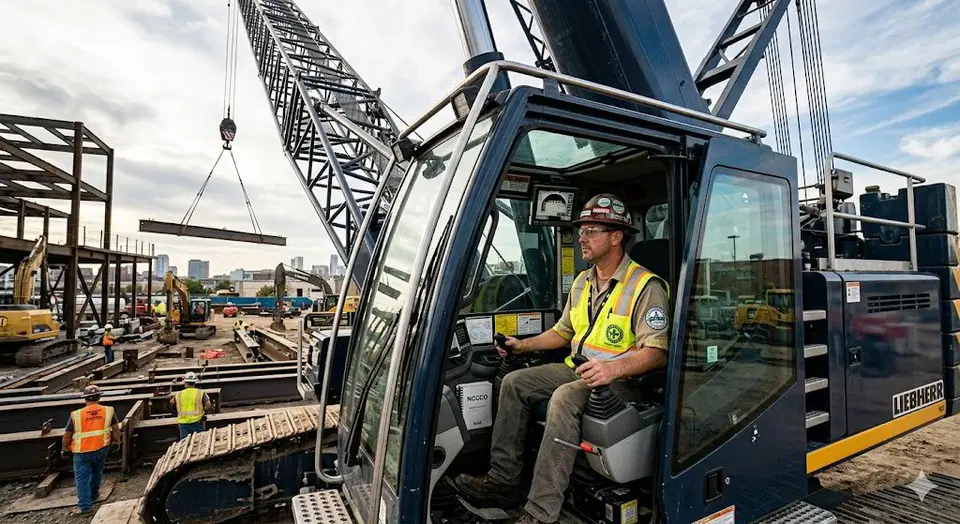
Lattice boom truck cranes are a familiar sight on industrial projects, steel erection and heavy equipment setting. They travel on a rubber-tired carrier, then rig a lattice boom that can reach farther and weigh less than a comparable telescopic boom. Running one well takes a different set of habits from running a hydraulic crane, and NCCCO recognizes that with a dedicated specialty designation: LBT.
Clearing up the abbreviations
NCCCO's mobile crane program uses four specialty designations, and they are easy to mix up:
| Designation | Stands for | Boom | Carrier |
|---|---|---|---|
| LBT | Lattice Boom Truck | Lattice sections | Rubber-tired truck carrier |
| LBC | Lattice Boom Crawler | Lattice sections | Crawler tracks |
| TLL | Telescopic boom, swing cab | Hydraulic telescoping | Truck, rough-terrain or all-terrain |
| TSS | Telescopic boom, fixed cab | Hydraulic telescoping | Truck (boom trucks) |
Note that TLL and TSS are telescopic crane designations. They have nothing to do with tower cranes or personnel lifting, despite how they are sometimes described online. Tower cranes have a separate NCCCO program.
For a closer look at the two lattice designations, see our post on the difference between LBT and LBC.
What makes LBT operation different
Assembly matters
Lattice booms are built from sections pinned together on site, along with the jib, counterweight and rigging for the hoist lines. The configuration you assemble determines which load chart applies. Operators must understand boom section order, pendant lines and how attachments change capacity. OSHA requires assembly and disassembly to be directed by a competent and qualified person, and many operators fill that role.
Charts with more variables
LBT load charts are organized by boom length, radius and often counterweight and outrigger configuration. Because the boom is lighter for its length, lattice cranes can dedicate more capacity to the load at long reach, but the margins are just as unforgiving. Deductions for the block, ball, rigging, and any jib or extension apply as they do on any mobile crane.
Outriggers and ground pressure
Like other truck-mounted cranes, LBTs work on outriggers. Ground preparation and proper mats are essential, especially for the heavy lifts these machines are often brought in for.
Wind and boom handling
A long lattice boom catches wind. Operators follow manufacturer wind limits and pay attention to boom angle limits, including backward stability when working at high angles with little or no load.
How LBT certification works
The NCCCO path for an LBT operator follows the same mobile crane structure as other designations:
- Pass the mobile crane Core written exam.
- Pass the LBT specialty written exam, focused on lattice boom truck configurations and charts.
- Pass the LBT practical exam at an approved site.
Candidates can take more than one specialty exam alongside the Core, so an operator who also runs crawlers may pursue LBC at the same time. Our NCCCO mobile crane certification overview explains eligibility, and the OECP lattice boom overview and CIC lattice boom overview cover alternative certifiers if your employer accepts them.
Comparing ways to prepare
Rather than ranking providers, it is more useful to compare the types of preparation available.
Self-paced online prep
- Strengths: Study around shifts, replay difficult chart problems, take practice tests as often as you like.
- Limits: No seat time. You still need hands-on practice on an LBT before the practical.
- Best for: Working operators who already have access to a machine through their employer.
Our LBT/LBC online training and lattice boom crane course follow this model.
Classroom prep
- Strengths: Instructor available for questions, set schedule keeps you on track, often paired with an on-site exam session.
- Limits: Time away from work and travel costs; pace is set by the group.
- Best for: Crews training together or learners who prefer structured, face-to-face teaching.
Hands-on training programs
- Strengths: Seat time under supervision, practical exam rehearsal.
- Limits: Usually the most expensive and least flexible option.
- Best for: Newer operators who need to build machine skills, not just exam knowledge.
Many operators combine them: online study for the written exams, supervised seat time for the practical. Our practical training guide explains how to plan that.
Who should pursue the LBT designation?
LBT makes the most sense when the machine is part of your actual work. Typical candidates include:
- Operators at crane rental companies whose fleets include lattice truck cranes.
- Steel erection and industrial maintenance crews that bring in lattice cranes for heavier picks.
- Experienced telescopic operators looking to move into larger, longer-reach equipment.
- Oiler or apprentice operators who already help assemble lattice booms and want to move into the seat.
If you mostly run crawler-mounted lattice cranes, LBC is the better first choice; if you run both, plan to take both specialty written exams together with the Core.
Using practice exams well
- Take a baseline test early to find weak areas.
- Focus practice on chart questions; they reward repetition.
- Simulate exam conditions: time limit, quiet room, only allowed references.
- Review every missed question until you can explain the right answer.
Staying certified
NCCCO certifications are valid for five years. Recertification requires passing the relevant written exams again before expiry and meeting experience requirements. If you plan to keep LBT on your card, put the date in your calendar and give yourself months, not weeks, to prepare.