
Getting the terms right
You will sometimes see these abbreviations expanded incorrectly online. In NCCCO's mobile crane program they mean:
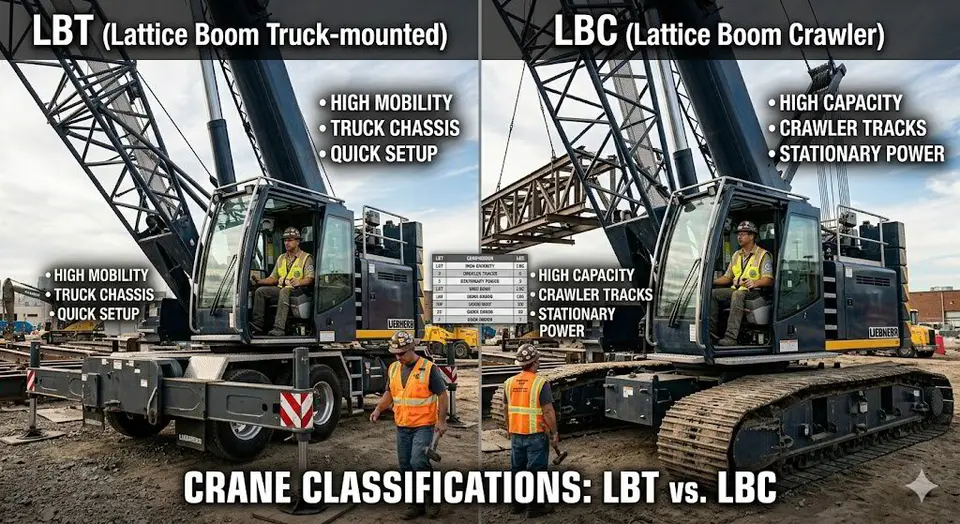
- LBT: Lattice Boom Truck. A lattice boom crane mounted on a wheeled truck carrier, set up on outriggers.
- LBC: Lattice Boom Crawler. A lattice boom crane mounted on crawler tracks.
Both use a lattice boom, an open steel truss built from pinned sections, rather than the nested telescoping sections of TLL and TSS cranes. A lattice boom is relatively light for its length and strength, which is why these cranes handle long reaches and heavy work. The carrier underneath is what separates them.
The carrier changes how the crane meets the ground
LBT: outriggers and pads
A lattice boom truck crane is driven or transported to site on its wheeled carrier, then leveled on outriggers. Its working stability depends on outrigger extension, the condition of the ground under each pad and the cribbing or mats used. Lifting "on rubber," on the tires instead of outriggers, may be allowed only where the manufacturer's chart provides for it, and capacities are much lower.
LBC: tracks spread the load
A crawler crane sits on two long track frames. The tracks spread the crane's weight over a large area, but loads still concentrate under the track edges as the upper swings and the load moves. Operators and lift planners must consider ground bearing capacity across the full swing, and crawlers are frequently set up on crane mats. Crawlers also need the ground to be level within the manufacturer's limits; tracks cannot be leveled the way outriggers can.
Travel and pick-and-carry
This is one of the clearest practical differences.
- LBC cranes can often travel with a suspended load, within strict limits stated on the load chart (boom position, ground slope, travel speed and reduced capacity). That makes them useful for moving heavy items short distances on site.
- LBT cranes are generally set up in one position for lifting. Moving means retracting outriggers, re-leveling and starting setup again.
Between jobs, a truck crane can often drive itself or travel with fewer support loads. A crawler is usually disassembled and transported on multiple trucks, then reassembled on site.
Assembly and disassembly
Both crane types are assembled from components, so both demand knowledge of boom section sequence, pin and pendant connections, counterweight installation and the manufacturer's assembly procedures. OSHA requires assembly and disassembly to be directed by a competent and qualified person under 29 CFR 1926.1404.
Crawlers typically involve more components on site, including track frames and larger counterweight packages on bigger models, and often need an assist crane. Truck-mounted lattice cranes can be quicker to rig, but boom assembly and pendant work remain significant tasks.
Load charts and configuration
Lattice boom charts tend to carry more variables than telescopic charts: boom length combinations, jib or luffing attachments, counterweight configuration, and different ratings for over-the-side, over-the-rear or 360° work. LBT charts add outrigger configuration; LBC charts add notes on travel, track position and ground level.
On the exams, both demand careful reading of chart notes and deductions. Our lattice boom crane prep focuses on this chart work.
Side-by-side comparison
| LBT (Lattice Boom Truck) | LBC (Lattice Boom Crawler) | |
|---|---|---|
| Carrier | Wheeled truck | Crawler tracks |
| Stability base | Outriggers and pads | Track frames, often on mats |
| Leveling | Adjusted with outriggers | Depends on prepared ground |
| Travel with load | Generally no | Often yes, within chart limits |
| Between sites | Often drives or moves with fewer loads | Usually disassembled and hauled |
| Typical work | Repeated setups, moderate to heavy lifts | Long-duration, heavy lifts, pick-and-carry |
Safety implications
Each design shifts the risks:
- LBT: outrigger placement, pad sizing and cribbing are critical. Partially extended outriggers require using the correct chart.
- LBC: ground preparation and mats, slope during travel, and loads that swing while moving demand discipline.
- Both: wind effects on long lattice booms, boom assembly errors, power line clearances under OSHA 1926.1407–1411, and correct use of the load moment indicator and anti-two-block devices.
How certification works for each
NCCCO treats LBT and LBC as separate specialty designations within mobile crane certification. Candidates pass the shared Core written exam plus the specialty written exam for each designation they want, and a practical exam on the matching crane type. If you operate both, plan for two specialty exams and two practicals.
Other bodies also certify lattice boom operators. Compare the CIC lattice boom crane overview and the OECP lattice boom crane overview if your employer prefers one of them.
Our LBT/LBC online training prepares candidates for the written exams on both designations. For hands-on preparation, read about practical training and seat time.
Studying for both designations
If you are preparing for LBT and LBC at once, organize your study around what is shared and what is different. The Core exam material, rigging, signals and power line rules apply to both. Specialty study should then focus on the differences: outrigger configurations and on-rubber ratings for LBT; travel limits, track position and ground conditions for LBC. Working through charts for each type side by side helps you notice how the notes differ, which is where many exam questions are aimed. Timed practice tests in the final weeks show whether you can switch between chart types without slipping.
Which one should you pursue?
Follow the equipment. If your company runs truck-mounted lattice cranes, LBT is the priority; if it runs crawlers on long-duration projects such as refineries, power generation or bridge work, LBC is. Operators who move between both kinds of work often hold both. For more on the truck side, see our LBT crane operator training guide.