
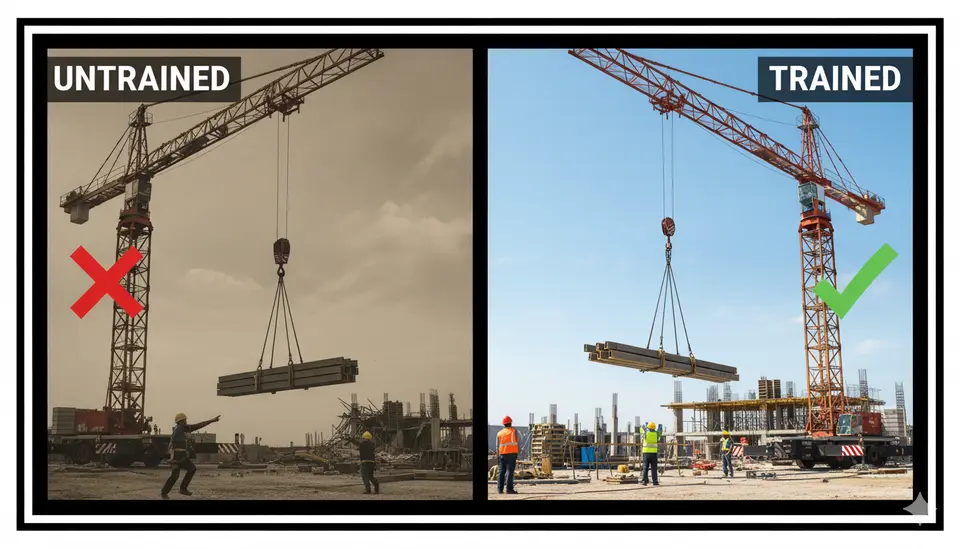
Why training carries so much weight on a construction site
Cranes on construction sites work in conditions that change daily: ground that was firm last week is soft after rain, a new trade moves into the swing radius, an overhead line is energized, a load arrives heavier than the paperwork says. Operators who understand why procedures exist are better at noticing when the situation no longer matches the plan.
Training also has direct business consequences. A crane incident can injure workers, damage the structure and equipment, halt the project and trigger investigations. Well-trained operators and crews reduce that exposure, and owners and general contractors increasingly look at a subcontractor's training practices when awarding work.
The training layers the rules expect
OSHA's construction crane standard, 29 CFR 1926 Subpart CC, builds operator competence in layers. Our detailed guide to OSHA crane certification requirements covers the rule text; here is the contractor's view.
- Certification. Operators must hold certification by crane type from an accepted source, typically an accredited testing organization such as NCCCO.
- Employer evaluation. The employer must evaluate each operator on the equipment and tasks they will be assigned and document it.
- Additional training. When an operator moves to unfamiliar equipment, configurations or attachments, the employer must provide training.
- Operator-in-training rules. Uncertified operators may run equipment only under specific supervision conditions.
- Crew qualifications. Signal persons must be qualified (1926.1428) and riggers must be qualified for specified tasks (1926.1404, 1926.1425).
A contractor that treats certification as the whole job misses layers two through five.
Comparing training methods
Each method has a role. The mistake is relying on one to do all the work.
| Method | Strengths | Limits | Best used for |
|---|---|---|---|
| Self-paced online | Flexible, consistent content, easy to track, revisit any time | No seat time; needs learner discipline | Written-exam prep, regulations, refreshers |
| Live online class | Instructor interaction without travel | Fixed schedule | Recertification reviews, group refreshers |
| Classroom | Discussion, team building | Travel and lost production | Crew-wide orientation, site-specific planning |
| Hands-on with mentor | Builds real control skill, judgment | Ties up equipment and senior staff | New operators, new equipment |
| Manufacturer familiarization | Model-specific detail | Narrow scope | New machines, new attachments |
A practical program usually combines online study for knowledge, mentored seat time for skill, and short in-person sessions for site-specific issues.
Where online training fits best
For construction contractors, self-paced online courses solve a scheduling problem. Operators can prepare for written exams in the evenings or during weather days without pulling a crane off the job. Content is the same for every learner, which makes it easier to show that everyone received the same baseline. Our crane course catalog includes written-exam prep for mobile, tower, lattice boom, articulating and other crane types.
Online training does not replace the practical exam, the employer evaluation or real seat time. It makes the knowledge side efficient so supervised field time can focus on skill.
Do not forget the rest of the crew
A skilled operator can still be undone by poor rigging or unclear signals. Contractors who train only operators often see problems shift to the ground crew. Consider:
- Signal person training for anyone who directs the crane. Our signal person course covers the knowledge side of qualification.
- Rigging training for the people hooking up loads, at Level I for routine work and Level II for those planning rigging. Our Rigger Level I guide explains the entry tier.
- General construction safety, such as the OSHA 30-Hour Construction course for supervisors.
- Lift director preparation for supervisors who own critical lifts.
Keeping skills current between certifications
NCCCO certifications last five years, which is a long time for skills to drift. Good programs include:
- Refreshers on regulations and load charts every so often, not just before recertification
- Toolbox talks built around real near misses on your own jobs
- Re-evaluation when an operator moves to a different crane or configuration
- Recertification planning that starts about a year before cards expire. Our recertification training supports that step.
Measuring whether training works
Training records show that people attended; they do not show that crews are safer. Contractors can look for more meaningful signs:
- Lift plans that are complete and actually followed
- Pre-lift meetings that happen on every critical lift
- Near misses reported and discussed rather than hidden
- Operators who stop work when conditions change, and supervisors who back them
- First-time pass results when operators sit certification or recertification exams
When those signs are missing, the issue is often not the course content but how training connects to daily practice on site.
Building a training program: a checklist
- Inventory your cranes by type and the operators who run each.
- Record certification type and expiry for every operator, signal person and rigger.
- Document employer evaluations for each operator and machine.
- Identify gaps: uncertified operators, expiring cards, crew members without signal or rigging qualification.
- Choose formats for each gap: online for knowledge, mentored seat time for skill.
- Schedule refreshers and re-evaluations.
- Review after every incident or near miss and adjust.
Our page on crane certification for construction workers shows how we support contractor teams.
The bottom line
Training is not a single event. In construction, it is a set of layers: certification, evaluation, equipment-specific instruction, crew qualification and ongoing refreshers. Contractors who build all of those layers, using online study where it saves time and hands-on work where skill is built, end up with crews that recognize trouble early and stop the job before it becomes an incident.